Tampilkan postingan dengan label black carbon. Tampilkan semua postingan

Jumat, 18 Juli 2014

Smoke Blankets North America


A thick layer of smoke blankets large parts of North America, as also illustrated by the animation below based on images from July 15 to 18, 2014, from Wunderground.com.

[ note that this animation is a 2.3MB file that may take some time to fully load ]
The are also extensive wildfires throughout the boreal forest and tundra zones of Central Siberia in Russia.

Such wildfires can send huge amounts of carbon dioxide, methane, soot, dust and volatile organic compounds into the atmosphere. Much of this gets deposited at higher latitudes, discoloring land, snow and ice, and thus speeding up warming by absorbing more sunlight that was previously reflected back into space.

Soils at higher latitudes can contain huge amounts of carbon in the form of peat, as described in the earlier post The Threat of Wildfires in the North. There are further conditions that make the situation in the Arctic so dangerous.
Temperature anomaly March-April-May-June 2014 (JMA)

The Arctic is particularly vulnerable to warming due to geographics. Seas in the Arctic Ocean are often shallow and covered by sea ice that is disappearing rapidly. Largely surrounded by land that is also rapidly losing its snow and ice cover, the Arctic Ocean acts like a trap capturing heat carried in by the Gulf Stream, which brings in ever warmer water. Of all the heat trapped on Earth by greenhouse gases, 90% goes into oceans, while a large part of the remaining 10% goes into melting the snow and ice cover in the Arctic, as described in an earlier post. Such basic conditions make that the Arctic is prone to warming.

Then, there are huge amounts of methane held in sediments under the Arctic Ocean, in the form of hydrates and free gas. Unlike methane releases from biological sources elsewhere on Earth, methane can be released from the seafloor of the Arctic Ocean in large quantities, in sudden eruptions that are concentrated in one area.

Until now, permafrost and the sea ice have acted as a seal, preventing heat from penetrating these methane hydrates and causing further destabilization. As long as there is ice, additional energy will go into melting the ice, and temperatures will not rise. The ice also acts as a glue, keeping the soil together and preventing hydrate destabilization from pressure changes and shockwaves resulting from seismic activity. Once the ice is gone, sediments become prone to destabilization and heat can more easily move down along fractures in the sediment, reaching hydrates that had until then remained stable.
 
Temperature anomaly March-April-May 2014 (NASA)
When methane escapes from the seafloor of the Arctic Ocean and travels through waters that are only shallow, there is little opportunity for this methane to be broken down in the water, so a lot of it will enter the atmosphere over the Arctic Ocean. The Coriolis effect will spread the methane sideways, but latitudes over the Arctic are relatively short, making the methane return at the same spot relatively quickly, while the polar jet stream acts as a barrier keeping much of the methane within the Arctic atmosphere. In case of large methane eruptions, the atmosphere over the Arctic will quickly become supersaturated with methane that has a huge initial local warming potential.

Hydroxyl levels in the atmosphere over the Arctic are very low, extending the lifetime of methane and other precursors of stratospheric ozone and water vapor, each of which have a strong short-term local warming potential. In June/July, insolation in the Arctic is higher than anywhere else on Earth, with the potential to quickly warm up shallow waters, making that heat can penetrate deep into sediments under the seafloor.

created by Sam Carana, part of AGU 2011 poster
The initial impact of this methane will be felt most severely in the Arctic itself, given the concentrated and abrupt nature of such releases, with the danger that even relatively small releases of methane from the seafloor of the Arctic can trigger further destabilization of hydrates and further methane releases, escalating into runaway warming.

This danger is depicted in the image on the right, showing how albedo changes and methane releases act as feedbacks that further accelerate warming in the Arctic, eventually spiraling into runaway global warming.

The currently very high sea surface temperature anomalies are illustrated by the two images below.


As the image below right shows, sea surface temperatures as high as 18 degrees Celsius (64.4 degrees Fahrenheit) are currently recorded in the Arctic.

Albedo changes and methane releases are only two out of numerous feedbacks that are accelerating warming in the Arctic.

Also included must be the fact that Earth is in a state of energy imbalance. Earth is receiving more heat from sunlight than it is emitting back into space. Over the past 50 years, the oceans have absorbed about 90% of the total heat added to the climate system, while the rest goes to melting sea and land ice, warming the land surface and warming and moistening the atmosphere.

In a 2005 paper, James Hansen et al. estimated that it would take 25 to 50 years for Earth’s surface temperature to reach 60% of its equilibrium response, in case there would be no further change of atmospheric composition. The authors added that the delay could be as short as ten years.

Earth's waters act as a buffer, delaying the rise in land surface temperatures that would otherwise occur, but this delay could be shortened. Much of that extra ocean heat may enter the atmosphere much sooner, e.g. as part of an El NiƱo event. Another buffer, Arctic sea ice, could collapse within years, as illustrated by the image below.

[ click on image to enlarge ]
The demise of sea ice comes with huge albedo changes, resulting in more heat getting absorbed by the Arctic Ocean, in turn speeding up warming of the often shallow waters of the Arctic Ocean. This threatens to make heat penetrate subsea sediments containing huge amounts of methane. Abrupt release of large amounts of methane would warm up the Arctic even more, triggering even further methane releases in a spiral of runaway warming.

Particularly worrying is the currently very warm water that is penetrating the Arctic Ocean from the Atlantic Ocean and also from the Pacific Ocean, as illustrated by the image further above and the image on the right.

The danger is that the Arctic will warm rapidly with decline of the snow and ice cover that until now has acted as a buffer absorbing heat, with more sunlight gets absorbed due to albedo changes and as with additional emissions, particularly methane, resulting from accelerating warming in the Arctic.

The numerous feedbacks that accelerate warming in the Arctic are pictured in the image below.

[ from: climateplan.blogspot.com/p/feedbacks.html ]
Furthermore, the necessary shift to clean energy will also remove the current masking effect of aerosols emitted when burning fuel. One study finds that a 35% – 80% cut in people's emission of aerosols and their precursors will result in about 1°C of additional global warming.

In the video below and the video further down below, Guy McPherson discusses Climate Change and Human Extinction.


This is further illustrated by the image below, showing how surface temperature rises are accelerating in the Arctic compared to global rises, with trendlines added including one for runaway global warming, from How many deaths could result from failure to act on climate change?
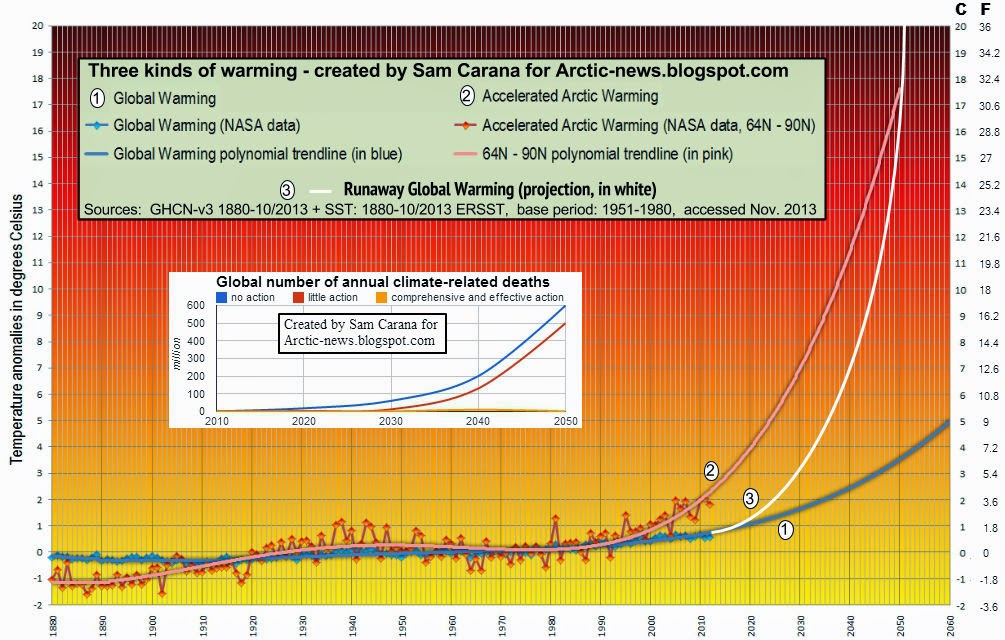
[ click on image to enlarge ]
The situation is dire and calls for comprehensive and effective action, as discussed at the Climate Plan blog.

Hat tip to Jim Kirkcaldy for pointing at the wildfire development at an early stage.

Rabu, 10 Juli 2013

Wildfires even more damaging

Wildfires cause even more damage than many climate models assume. Much has been written about the threat that wildfires pose to people's safety and health, to crop yields, and the quality of soils and forests.

In addition, wildfires pose a huge threat in terms of climate change, not only due to the impact of emissions on the atmosphere, but there's also the impact of particles (soot, dust and volatile organic compounds) settling down on snow and ice, speeding up their demise through albedo changes. This contributes to the rapid decline of the sea ice and snow cover in the Arctic, a decline that has been hugely underestimated in many climate models.

Furthermore, global warming and accelerated warming in the Arctic cause extreme weather conditions in many places, an impact that is again underestimated in many climate models.

A team of scientists from Los Alamos and Michigan Technological University, led by Swarup China, points out that continued global warming will make conditions for wildfires worse, as was already noted in earlier studies, such as this 2006 study. They also point at the conclusion of a recent study that more biomass burning will lead to more ozone, less OH, and a nonlinear increase of methane's lifetime.

Mixing and classification of soot particles. Field-emission
scanning electron microscope images of four different
categories of soot particles: (a) embedded, (b) partly coated,
(c) bare and (d) with inclusions. Approximately 50% of the
ambient soot particles are embedded, 34% are partly coated
and 12% have inclusions. Only 4% of the particles are bare
soot (not coated or very thinly coated). Scale bars, 500 nm.
Right, spherical tar balls dominate in the emissions.
The scientists recently completed an analysis of particles from the Las Conchas fire that started June 26, 2011, and was the largest fire in New Mexico's history at the time, burning 245 square miles. One of the scientists, Manvendra Dubey, said

 “Most climate assessment models treat fire emissions as a mixture of pure soot and organic carbon aerosols that offset the respective warming and cooling effects of one another on climate. However Las Conchas results show that tar balls exceed soot by a factor of 10 and the soot gets coated by organics in fire emissions, each resulting in more of a warming effect than is currently assumed.”
“Tar balls can absorb sunlight at shorter blue and ultraviolet wavelengths (also called brown carbon due to the color) and can cause substantial warming,” he said. “Furthermore, organic coatings on soot act like lenses that focus sunlight, amplifying the absorption and warming by soot by a factor of 2 or more. This has a huge impact on how they should be treated in computer models.”

Finally, many climate models ignore the threat of large, abrupt methane releases in the Arctic. As discussed in many earlier posts at Arctic-news blog, accelerated warming in the Arctic threatens to spiral out of control as methane levels rise over the Arctic, causing destabilization of methane hydrates and further methane releases, escalating into runaway global warming. 

Rabu, 02 Januari 2013

Turning forest waste into biochar

Too much biomass waste in tundra and boreal forests makes them prone to wildfires, especially when heatwaves strike. Furthermore, leaving biomass waste in the forest can cause a lot of methane emisions from decomposition.

In order to reduce such methane emissions and the risk of wildfires, it makes sense to reduce excess biomass waste in fields and forests. Until now, this was typically done by controlled burning of biomass, which also causes emissions, but far less than wildfires do. Avoiding wildfires is particularly important for the Arctic, which is vulnerable to soot deposits originating from wildfires in tundra and boreal forest. Such soot deposits cause more sunlight to be absorbed, accelerating the decline of snow and ice in the Arctic.


A team of scientists at University of Washington, sponsored by the National Science Foundation, has developed a way to remove woody biomass waste from forests without burning it in the traditional way. The team has developed a portable kiln that can be assembled around a heap of waste wood and convert it to biochar on the spot, while the biochar can also be burried in the soil on the spot.

Demonstration in Kerby, Oregon,
Nov. 6, 2012, 
 by Carbon Cultures
Credit: 
Marcus Kauffman at Flickr
The team initially started testing the effectiveness of a heat-resistant blanket thrown over woody debris.  The team then developed portable panels that are assembled in a kiln around a slash pile.

Students have set up a company, Carbon Cultures, to promote the technology and to sell biochar. CEO of Carbon Cultures is Jenny Knoth, also a Ph.D. candidate in environmental and forest sciences.

The kiln restricts the amount of oxygen that can reach the biomass, which is transformed by pyrolysis into biochar. The woody waste is heated up to temperatures of about 1,100 degrees Fahrenheit (600 Celsius), as the kiln transforms some 800 pounds of wood into 200 pounds of biochar in less than two hours. “We also extinguish with water because it helps keep oxygen out and also activates the charcoal [making it more fertile in soil].”

Currently, the total costs of disposing of forest slash heaps (the collections of wood waste) approximate a billion dollars a year in the United States, according to Knoth.

And of course, adding biochar to the soil is a great way to reduce carbon dioxide levels in the atmosphere. “Biochar is proven to fix carbon for hundreds of thousands of years,” Knoth said.
Demonstration in Kerby, Oregon, November 6, 2012, organized by Carbon Cultures Credit: Marcus Kauffman at Flickr

As said, when biomass waste is left in the open air, methane emissions are produced during its decomposition. Moreover, such waste will fuel wildfires, which produce huge amounts of emissions. The traditional response therefore is to burn such waste. Pyrolyzing biomass produces even less greenhouse gases and less soot, compared to such controlled burning.

Biochar is produced in the process, which can be added to the soil on the spot. This will help soil retain moisture, nutrients and soil microbes, making forests more healthy, preventing erosion and thus reduces the risk of wildfires even further, in addition to the reduction already achieved by removal of surplus waste.

A healthy forest will retain more moist in its soil, in the air under its canopy, and in the air above the forest through expiration, resulting in more clouds that act as sunshades to keep the forest cool and return the moist to the forest through rainfall. Forests reinforce patterns of air pressure and humidity that result in long-distance air currents that bring moist air from the sea inland to be deposited onto the forest in the form of rain. Finally, clouds can reflect more sunlight back into space, thus reducing the chance of heatwaves.

References

Recycling wood waste - The Daily of the University of Washington
Helping Landowners with Waste Wood While Improving Agribusiness and Energy - National Science Foundation

Related

- Biochar
- CU-Boulder gets into biochar

Sabtu, 01 Desember 2012

Aviation Policies

The European Union's policy on Aviation Emissions

From the start of 2012, the European Union (EU) required its members to include emissions from flights arriving at and departing from their airports in the EU scheme of emissions allowances and trading, while encouraging other nations to take equivalent measures. The EU exempts biofuel and claims to take a 'comprehensive approach' to reducing environmental impacts of aviation. To create space for political negotiations to get an international agreement regulating emissions from aviation, the EU has meanwhile postponed implementation of its directive by one year.

What kind of international agreement could be reached on aviation emissions? What policies work best? How do aviation policies fit into a comprehensive approach?

A Comprehensive Plan of Action on Climate Change

A comprehensive plan is best endorsed globally, e.g. through an international agreement building on the Kyoto Protocol and the Montreal Accord. At the same time, the specific policies are best decided and implemented locally, e.g. by insisting that each nation reduces specific emissions by a set annual percentage, and additionally removes a set annual amount of carbon dioxide from the atmosphere and the oceans, followed by sequestration, proportionally to its current emissions.

Policy goals are most effectively achieved when policies are implemented locally and independently, with separate policies each addressing the specific shifts that are each needed to reach agreed targets. Each nation can work out what policies best fit their circumstances, as long as they each independently achieve agreed targets. Counting emissions where they occur will encourage nations to adopt effective policies, such as imposing fees on the sales of products in proportion to the emissions they cause, and adopting product standards that ban products that would otherwise cause unacceptably high emissions while clean alternatives are readily available.


Clean Energy Policies

Policies aiming to achieve a shift to clean energy will apply to many sectors such as transportation (including aviation), power plants, and industry and buildings which are also large consumers of fossil fuel. The above image also shows policies specifically targeting aviation, in addition to clean energy policies that apply across sectors.

The image below proposes feebates as the most effective way to accomplish the necessary shift to clean energy. In such feebates, fees are imposed on polluting energy and associated facilities, with revenues used - preferably locally - to fund rebates on clean energy and associated facilities.


In line with such feebates, each nation could impose fees on jetfuel, while using the revenues for a variety of purposes, preferably local clean energy programs. Where an airplane lands arriving from a nation that has failed to add sufficient fees, the nation where the airplane lands could impose supplementary fees. Such supplementary fees should be allowed under international trade rules, specifically if revenues are used to fund direct air capture of carbon dioxide.

Aviation Policies

As said, apart from clean energy policies, it makes sense to additionally implement policies specifically targeting aviation. Airplanes not only cause carbon dioxide emissions, but also cause other emissions such as black carbon and NOx, contrails and cirrus cloud effects. The EU emissions scheme only targets a limited set of emissions, while also looking at their global warming potential, rather than the potential of emissions to cause warming locally, specifically in the Arctic. A joint 2011 UNEP/WMO report mentioned many measures to reduce black carbon and tropospheric ozone, adding that their implementation could reduce warming in the Arctic in the next 30 years by about two-thirds.

A 2012 study by Jacobson et al. concludes that cross-polar flights by international aviation is the most abundant direct source of black carbon and other climate-relevant pollutants over the Arctic. Rerouting cross-polar flights to instead circumnavigate the Arctic Circle therefore makes sense. While such rerouting consumes more fuel, it could reduce fuel use and emissions within the Arctic Circle by 83% and delay pollutant transport to the Arctic.

Given the need to act on warming in the Arctic, it makes sense to ban cross-polar flights. To further reduce the flow of pollutants to the Arctic caused by aviation, it makes sense to add fees on all jet flights. Such fees on jet flights would be additional to the above fees on fuel. This could further facilitate a shift from aviation toward cleaner forms of transportation, such as high speed rail. Where the revenues of such fees are used to fund direct air capture, they could also help kickstart an industry that could produce synthetic jetfuel and that could be instrumental in bringing atmospheric levels of carbon dioxide back to 280ppm.

Selasa, 24 Juli 2012

Greenland is melting at incredible rate

The combination-image below shows how much the ice on Greenland melted between July 8 (left) and July 12 (right).

On July 8, about 40% of the ice sheet had undergone thawing at or near the surface. In just a few days, the melting had dramatically accelerated and some 97% of the ice sheet surface had thawed by July 12. 

In the image, the areas classified as “probable melt” (light pink) correspond to those sites where at least one satellite detected surface melting. The areas classified as “melt” (dark pink) correspond to sites where two or three satellites detected surface melting. The satellites are measuring different physical properties at different scales and are passing over Greenland at different times. Credit: Nicolo E. DiGirolamo, SSAI/NASA GSFC, and Jesse Allen, NASA Earth Observatory.
For several days this month, Greenland's surface ice cover melted over a larger area than at any time in more than 30 years of satellite observations. Nearly the entire ice cover of Greenland, from its thin, low-lying coastal edges to its two-mile-thick center, experienced some degree of melting at its surface, according to measurements from three independent satellites analyzed by NASA and university scientists.

On average in the summer, about half of the surface of Greenland's ice sheet naturally melts. At high elevations, most of that melt water quickly refreezes in place. Near the coast, some of the melt water is retained by the ice sheet and the rest is lost to the ocean. But this year the extent of ice melting at or near the surface jumped dramatically. According to satellite data, an estimated 97% of the ice sheet surface thawed at some point in mid-July.

This extreme melt event coincided with an unusually strong ridge of warm air, or a heat dome, over Greenland. The ridge was one of a series that has dominated Greenland's weather since the end of May. "Each successive ridge has been stronger than the previous one," said Mote. This latest heat dome started to move over Greenland on July 8, and then parked itself over the ice sheet about three days later. By July 16, it had begun to dissipate.

As the ice warms, it loses albedo, i.e. less sunlight is reflected back into space. Darker surface absorbs more sunlight, accelerating the melting. The image below shows the Greenland ice sheet albedo from 2000 to 2011.

Credit: NOAA Arctic Report Card 2011.

The image below, from the meltfactor blog and by Jason Box and David Decker, shows the steep fall in reflectivity for altitudes up to 3200 meters in July 2012. 


The image below, from the meltfactor blog, shows how the year 2012 compares with the situation at approximately the same time in previous years, 2011 and 2010, which are recognized as being record melt years. 


The photo below shows how dark the ice sheet surface can become.

Photo shot by Jason Box on August 12, 2005
Loss of albedo occurs as the darker bare ground becomes visible where the ice has melted away. Darkening of snow and ice can start even before melting takes place. Warming changes the shape and size of the ice crystals in the snowpack, as described at this NASA Earth Observatory page. As temperatures rise, snow grains clump together and reflect less light than the many-faceted, smaller crystals. Additional heat rounds the sharp edges of the crystals, and round particles absorb more sunlight than jagged ones. 

Dirty ice surrounds a meltwater stream near the margin of the ice sheet. Compared to fresh snow and clean ice, the dark surface absorbs more sunlight, accelerating melting. © Henrik Egede Lassen/Alpha Film, from the Snow, Water, Ice, and Permafrost in the Arctic report from the U.N. Arctic Monitoring and Assessment Programme. From NOAA Climatewatch.
Another factor contributing to darkening is aerosols, in particular soot (i.e. black carbon) from fires and combustion of fuel, dust and organic compounds that enter the atmosphere and that can travel over long distances and settle on ice and snow in the Arctic. 

The July data since 2000, from the meltfactor blog, suggest a exponential fall in reflectivity that, when projected into the future (red line, added by Sam Carana), looks set to go into freefall next year. 

Is a similar thing happening all over the Arctic? Well, the map below, edited from a recent SSMIS Sea Ice Map, shows that sea ice concentration is highest around the North Pole. 


So, can water be expected to show up at the North Pole? Well have a look at the photo from the North Pole webcam below. 


Photo from the North Pole webcam
It does look like melting is going on at the North Pole. Water is significantly darker than ice, meaning the overall reflectivity will be substantially lowered by this water. 

It's important to realize that surface albedo change is just one out of a number of feedbacks, each of which deserves a closer look. 

As shown on the image below, the IPCC describes four types of feedbacks with a joint Radiative Forcing of about 2 W/sq m, i.e. water vapor, cloud, surface albedo and lapse rate. 


The image below, from James Hansen et al., may at first glance give the impression that all aerosols have a cooling effect. 


When components are split out further, it becomes clear though that some aerosols are reflective and have a cooling effect, whereas black carbon has a warming effect, while changes in snow albedo also contribute to warming. On the interactive graph below, you can click on or hover over each component to view their radiative forcing. When isolated from other factors, it's clear that snow albedo has an increasing warming effect.
How much could Earth warm up due to decline of snow and ice? Professor Peter Wadhams estimates that the drop in albedo in case of total loss of Arctic sea ice would be a 1.3 W/sq m rise in radiative forcing globally, while additional decline of ice and snow on land could push the the combined impact well over 2 W/sq m.

Locally, the impact could be even more dramatic. The image below, from Flanner et al., shows how much the snow and ice is cooling the Arctic. 


Image, edited by Sam Carana, from Mark Flanner et al. (2011).
Conversely, above image shows how much the Arctic could warm up without the snow and ice. Due to albedo change, sunlight that was previously reflected back into space will instead warm up the Arctic. What could have a big impact locally is that, where there's no more sea ice left, all the heat that previously went into melting will raise temperatures instead, as described at Warming in the Arctic.

The big danger is methane. Drew Shindell et al. show in Improved Attribution of Climate Forcing to Emissions that inclusion of aerosol responses will give methane a much higher global warming potential (GWP) than the IPCC gave methane in AR4, adding that methane's GWP would likely be further increased by including ecosystem responses. Indeed, as pictured in the image below, accelerated warming in the Arctic could trigger methane releases which could cause further methane releases, escalating into runaway global warming


Jumat, 09 Maret 2012

Berkeley Lab Quantifies Effect of Soot on Snow and Ice, Supporting Previous Climate Findings


A new study shows how soot darkens snow and ice, which upsets earth’s radiation balance.


A new study from scientists at the Lawrence Berkeley National Laboratory (Berkeley Lab), published in Nature Climate Change, has quantitatively demonstrated that black carbon—also known as soot, a pollutant emitted from power plants, diesel engines and residential cooking and heating, as well as forest fires—reduces the reflectance of snow and ice, an effect that increases the rate of global climate change.

Soot can travel great distances and settle back to earth in remote areas far from the emission source. If it deposits on snow-covered areas such as the poles or glaciers, it darkens the snow and ice, with the result that less solar radiation is reflected back into space. More heat is retained near the earth’s surface, speeding up global warming.

Although computer models of global climate have estimated this effect, the impact of soot on snow and ice albedo had not been thoroughly measured until now.

Snow manufactured in the laboratory 
Odelle Hadley and Thomas Kirchstetter of Berkeley Lab’s Environmental Energy Technologies Division developed new techniques to generate snow in the laboratory, and to mix it in varying concentrations with soot, which normally does not mix well in water. Using these methods, they measured the reflectance of snow with concentrations of soot varying from none to 1,700 parts per billion (ppb), which spans the range of concentrations measured in snow worldwide.

“We were able to demonstrate clearly that soot in snow reduces its albedo [reflectance],” says Kirchstetter. “We also showed that as you increase the concentration of soot in the snow, you further decrease its reflectance.”

Adds Hadley: “Another goal of our study was to validate the snow radiation modules used in general circulation models that predict anthropogenic climate change.”

The researchers also demonstrated that the greater the grain size of snow, the larger the decrease in its reflectance associated with a fixed amount of soot. Larger-grained snow allows sunlight to travel deeper into the snowpack than smaller-grained snow. Grain size is a proxy for the snow’s age because larger-grained snow is older than smaller-grained snow.

Black carbon depositing on snow may cause it to melt and refreeze into larger grains more quickly than would normally occur. The same amount of black carbon causes a bigger decrease in reflectance of large-grained snow than smaller-grained snow. The researchers were able to work out the quantitative relationship between increasing black carbon deposition and snow reflectance reduction with increasing snow grain size—a relationship that had been estimated in computer models, but not verified until now.

These results are significant because they provide an experimental check on the methods used to calculate the impact of black carbon on global climate in computer models. Hadley and Kirchstetter’s research show that there is good agreement between their lab measurements and the Snow Ice and Aerosol Radiation (SNICAR) Model, which is being used by the Intergovernmental Panel on Climate Change in its next climate assessment report.

How soot accelerates climate warming

Emissions of carbon dioxide are the largest contributor to global climate change. Black carbon, a particle emitted during fossil fuel and biomass combustion, adds further warming.

“Theoretical calculations suggest that small amounts of soot, 10 to 100 ppb by mass, can decrease the reflectance of snow 1 to 5 percent,” says Hadley. “This reduction contributes to climate change because it allow less of the sun’s radiation to reflect back into space. Snow is the most reflective natural surface on earth.” As snow falls it washes black carbon out of the air onto the snow pack. Typical field concentrations of black carbon are measured at 10 to 20 ppb, but in places scientists have measured concentrations as high as 500 ppb.

In snow covered regions, including the Arctic and the Himalayas, the local radiative forcing due to soot deposition is comparable to that exerted by carbon dioxide added to the atmosphere since preindustrial times. (Radiative forcing is a measure of how pollutants alter earth’s radiation balance with space, and scientists use it to compare the relative impacts of various pollutants on climate.)

Snow-making in the lab

“We needed to pioneer new techniques to do this study, including developing a way to make snow in the laboratory, and to get soot into water,” says Hadley. The researchers solved the first problem with a stack of Styrofoam coolers, liquid nitrogen, and a pressurized spray vessel. They sprayed the water into the top of the cooler stack with liquid nitrogen at the bottom. As the water droplets met the cold air  (-100°C to -130°C) below, it turned to snow. They learned to control the size of the snow grains by changing the nozzle size and water pressure through the nozzle.

They developed a method of generating soot with no other contaminants (such as oil) with the help of a type of non-premixed methane-air flame created by another Berkeley Lab scientist, Don Lucas. And they captured the soot they created using a filter, and exposed it to ozone, which is known to render soot particles chemically more prone to distribute themselves evenly in water. They developed, as well, a new method for measuring the amount of soot in water.

With these methods in place, the team now had a way of creating water with any desired soot concentration, and then turning it into snow, whose reflectance they could measure. 
They developed ways of using an integrating sphere-equipped spectrometer to measure the reflectance of snow.

In addition to the experimental work, they estimated the effect of black carbon on snow using the SNICAR model as a step toward verifying the impacts predicted by climate models. SNICAR was developed by former Berkeley Lab researcher Mark Flanner, now at the University of Michigan.

Next steps

Hadley’s and Kirchstetter’s research provides strong experimental evidence that the climate models are correctly estimating the effect on climate of less solar radiation reflected back into space because of the decrease in snow and ice’s reflectance. In future work, they aim to investigate if the black carbon is causing the earth’s snow and ice to melt faster, an effect that scientists suspect may be happening, but has not yet been demonstrated. Previous research by former Berkeley Lab scientist Surabi Menon suggests that black carbon contributes significantly to the melting of glaciers in the Himalayas.

They are also working with the University of California’s Central Sierra Snow Lab to begin studying how black carbon travels through snow as the snow pack melts.

This research was supported by the California Energy Commission’s Public Interest Energy Research program, the U.S. Department of Energy Office of Science, and a Lawrence Berkeley National Laboratory E.O. Lawrence Fellowship for Hadley. The article “Black Carbon Reduction of Snow Albedo” can be found online here.

# # #

Lawrence Berkeley National Laboratory addresses the world’s most urgent scientific challenges by advancing sustainable energy, protecting human health, creating new materials, and revealing the origin and fate of the universe. Founded in 1931, Berkeley Lab’s scientific expertise has been recognized with 13 Nobel prizes. The University of California manages Berkeley Lab for the U.S. Department of Energy’s Office of Science. For more, visit www.lbl.gov


Source:
newscenter.lbl.gov/news-releases/2012/03/05/snow-albedo

Related:
- Pollutants key to climate fix

- Simultaneously Mitigating Near-Term Climate Change and Improving Human Health and Food Security

- UNEP report on black carbon and ozone

- UNEP and WHO synthesis report