Tampilkan postingan dengan label snow. Tampilkan semua postingan

Jumat, 15 Agustus 2014

Heatwave to hit Greenland

A heatwave with temperature anomalies exceeding 36°F (20°C) is expected to hit Greenland between August 16 and 22, 2014, as illustrated by the image on the left and the animation on the right. 

Such heatwaves can be expected to hit the Arctic more frequently and with greater intensity, as temperatures in the Arctic are rising faster than elsewhere on Earth.

Such heatwaves can result in massive melting on Greenland, as persistent heat changes the texture of the snow and ice cover, in turn reducing its reflectivity. This makes that less sunlight is reflected back into space and is instead absorbed. 

The image below illustrates what a difference the presence of sea ice can make.
from: Arctic Warming due to Snow and Ice Demise
As the NSIDC/NOAA graphs below shows, melting on Greenland has been relatively modest this year when compared to the situation in 2012. By July 12, 2012, 97% of the ice sheet surface had thawed, according to this NASA analysis and this NOAA Arctic Report Card.


Melting on Greenland directly affects sea level rise, and melting on Greenland is accelerating due to a number of factors.

Projections of melting on Greenland have long been based on a warming atmosphere only, ignoring the warmer waters that lubricate glaciers and that warm Greenland's bedrock canyons that sit well below sea level.

Furthermore, there are growing quantities of black carbon deposits as a result of burning of fossil fuel and biomass. High temperatures have recently caused ferocious wildfires in Canada that have in turn caused a lot of black carbon to go up high into the atmosphere.

And of course, the atmosphere over the Arctic is warming up much faster than most models had projected. This in turn causes triggers further feebacks, including more extreme weather events such as heatwaves and rain storms that can be expected to hit Greenland with ever more frequency and ferocity. Further feedbacks include methane eruptions from the heights of Greenland, as discussed at the Arctic Feedbacks Page.

When also taking into account the accelerating impact of such factors on melting in Greenland, sea levels could rise much faster than anticipated, as illustrated by the image below.

from: more than 2.5m sea level rise by 2040? 

Note that sea level rise is only one of the many dangers of global warming, as discussed in the 2007 post Ten Dangers of Global Warming.

The image on the right shows a temperature forecast for August 16, 2014, with parts of Greenland changing in color from blue into green, i.e. above the melting point for snow and ice.

Such high temperatures are now hitting locations close to the North Pole ever more frequently, due to the many feedbacks that are accelerating warming in the Arctic, as discussed at this Feedbacks page.

One of the most dangerous feedbacks is a sudden eruption of huge quantities of methane from the seafloor of the Arctic Ocean, as discussed in a recent post.

The impact of such feedbacks can be accumulative and interactive, resulting in self-reinforcing feedbacks loops that can escalate into runaway warming.

Below is another forecast by ClimateReanalyzer for August 16, 2014, showing the remarkable ‘greening’ of Greenland, as well as the very high temperatures reaching the higher latitudes of North America.


Also see the very high sea surface temperatures around Greenland on the image below, created with ClimateReanalyzer.

Sea surface temperature anomalies on August 15, 2014. 
In conclusion, the situation is dire and calls for comprehensive and effective action, as discussed at the Climate Plan blog


Sabtu, 15 Februari 2014

Extreme weather strikes around the globe - update

As the weather gets more extreme, disaster strikes around the globe. The Guardian reports three people killed as storms continue to batter southern UK. The Vancouver Sun reports that a U.S. Northeast snowstorm kills 25. And the Sacramento Bee reports Six dead and 1,000 injured in fresh Japan snow storm.

What is the story behind these extreme weather events? The image below tells the story. The Arctic has been much warmer than it used to be, due to numerous feedbacks that accelerate warming in the Arctic. This reduces the temperature differential between the Arctic and lower latitudes, which changes the Jet Stream and Polar Vortex, in turn making the weather at many places ever more extreme.

 earlier forecasts by cci-reanalyzer.org
Above image illustrates the situation, showing an Arctic Ocean that is warmer than the higher latitudes of the Asian and North American continents.

Arctic sea ice has meanwhile reached record lows, as illustrated by the image below.


The situation can be expected to get even worse. The image below shows sea ice extent, as measured by the NSIDC, which is one day ahead compared to above image.


Below, two regular contributors to the Arctic-news blog comment on the situation.


    Paul Beckwith:

Paul Beckwith with sign (arrows highlighted by Sam Carana, from earlier post)
In the video below, Paul Beckwith discusses the above sign and the situation in general.


Dr. Malcolm Light, Earth Scientist, comments:


The volume of water transported by Gulf Stream off the east coast of the United States has increased by three times since the 1940s due to a massive increase in wind drag. This increase in the south westerly wind drag is a result of the continuously increasing pressure difference set up between the continental air mass over North America, heated by fossil - fuel generated carbon dioxide, and the marine air of the Atlantic.

The increased energy entering the Gulf Stream as heat and its associated winds and storm systems are what are now pummeling Great Britain and Europe. This heat is also transported further north by branches of the Gulf Stream into the Arctic Ocean, where it is destabilizing the subsea methane hydrates, releasing increasing volumes of methane into the Arctic atmosphere and causing temperature anomalies this last winter of more than 20 degrees Celsius.

As a consequence of the extremely high Arctic temperatures and pressures, the normal freezing Arctic air has been displaced into Canada and the United States, causing catastrophic blizzards that have never been seen before. When the floating Arctic ice cap melts towards the end of next year, the Arctic Ocean will then become more aggressively heated by the sun and the northern offshoots of the Gulf Stream.

Under these circumstances, the cold Arctic air will be confined over the Greenland ice cap and the Arctic atmosphere will rotate anticlockwise around Greenland, transferring the fast-increasing amounts of its atmospheric methane to Canada and the United States and causing a further increase in the energy of the Gulf Stream.

Therefore the United Kingdom and Europe must brace themselves for even more catastrophic weather systems, widespread flooding and massive wind damage from the start of the last quarter of next year.


Below is a comparison of methane readings for the week from February 9 to 16, 2014, compared to the same period in 2013.


The comparison shows that there is a lot of methane over the Arctic Ocean that wasn't there last year. Furthermore, high methane readings show up where currents move the sea ice out of the Arctic Ocean, in areas such as Baffin Bay. This indicates that methane that is released from the seafloor of the Arctic Ocean appears to be moving underneath the ice and entering the atmopshere where the sea ice is fractured or thin enough to allow the methane to pass through.

Also note that more orange areas show up on the southern hemisphere in 2014, indicating that more methane from the northern hemisphere is now spreading south beyond the equator. This in addition to indications that more methane is rising and building up at higher altitudes, as discussed in an earlier post.

As said before, the situation calls for comprehensive and effective action, as discussed at the Climate Plan blog.


Senin, 10 Februari 2014

Extreme weather strikes around the globe

  Editorial note: this post has meanwhile been updated as
Extreme weather strikes around the globe update.


As the weather gets more extreme, disaster strikes around the globe.

Here's a snapsnot from today's news. In London, the BBC reports, flooded homes along the River Thames are being evacuated and thousands more are at risk. In Japan, reports Reuters, eleven people died, more than a thousand were injured and tens of thousands lost power when the worst snowstorm in decades hit Tokyo and areas around the Japanese capital before heading north to blanket the tsunami-hit Pacific coast. Many countries in the Middle East were hit by snow. The BBC reports that heavy snow in northern Iran has left around 480,000 homes without power and some towns and villages cut off.

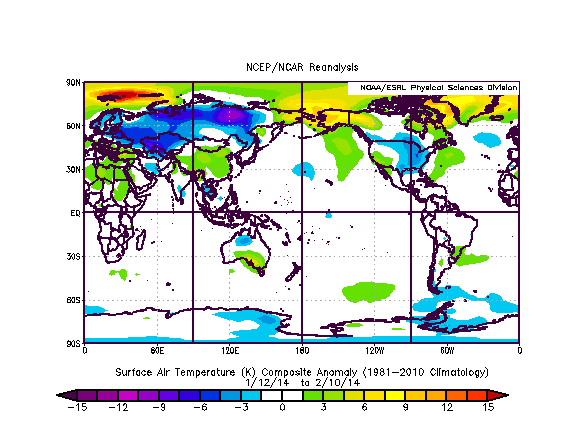
What is causing these extreme weather events? The image below tells the story. While at times it has been cold at many places around the world, when averaged over the past 30 days, temperatures around the globe have actually been several degrees higher than they used to be. The Arctic has been hit hardest, with anomalies as high as 21°C over this 30 day period. This affects the Jet Stream and Polar Vortex, which in turn is making the weather ever more extreme.


The situation is further illustrated by the cci-reanalyzer.org forecasts below.


And while the sea ice didn't look too bad at the start of the year, growth has meanwhile stopped, as illustrated by the image below.


Added below are two videos by Paul Beckwith, further discussing the situation.


Editor's note: Reanalysis of temperature anomaly Jan 12 - Feb 10, 2014.
Meanwhile, I've added another image (above), created with NOAA's reanalysis, which compares temperatures to a larger dataset, and the colors look a lot different, so NOAA may indeed have mixed the colors up somewhat in the initial image, as Albert suggested at the Facebook discussion (click on image below).

Anyway, the point made in the post remains, i.e. that as global warming continues, warming in the Arctic accelerates more rapidly than at lower latitudes, which weakens the polar vortex and jet stream in a self-reinforcing feedback that causes the Arctic to warm up even further compared with lower latitudes.

As said, the situation calls for comprehensive and effective action, as discussed at the Climate Plan blog.


Kamis, 12 September 2013

Temperature Rise

Surface Temperature Rise

How much have temperatures risen over the past 100 years or so? In the image below, Peter Carter points at the aerosols from volcanic eruptions and fossil fuel combustion that temporarily delay the full impact of global warming.


Temperature Rise hits Arctic most strongly

In above image, temperature anomalies are compared to a 3-decade base period from 1951 to 1980. To highlight the full wrath of global warming, it is more informative to compare anomalies with an earlier base period. Furthermore, a short running mean better shows how high peaks can reach.


NASA typically compares temperature change relative to 1951-1980, because the U.S. National Weather Service uses a three-decade period to define "normal" or average temperature. The NASA GISS analysis effort began around 1980, so the most recent 30 years at the time was 1951-1980.1

But as said, it is more informative to use a 30-year base period that starts earlier. To show Gobal & Arctic Temperature Change, James Hansen and Makiko Sato used a 1951-1980 base period next to a 1880-1920 base period. For this post, a 1883-1912 base period was selected to create the above image, and this same base period was selected to create the image below.


Above image shows that the Arctic is hit most strongly by the temperature rise. Note that the anomalies in above image are visualized by latitude, but are averaged by longitude globally, masking even higher anomalies that can be experienced at specific longitudes. At times, some areas in the Arctic do already experience anomalies of over 20°C, as shown in the animation below, based on NOAA data for the period December 7, 2011 - January 21, 2012.

[ Note: above animation is a 3MB file that may take some time to fully load ] 
Above animation was created by Sam Carana for the page Warming in the Arctic, which adds that the anomaly can be even more striking for individual days and locations. On January 6, 2011, the minimum temperature in Coral Harbour, located at the northwest corner of Hudson Bay in the province of Nunavut, Canada, was –3.7°C (25.3°F), i.e. 30°C (54°F) above average.2

The danger is that extreme weather events will cause waters in the Arctic Ocean to warm up, in turn causing heat to penetrate deep into the seabed and triggering destablization of methane held in the sediment in the form of hydrates or free gas. Ways for this to eventuate were also recently discussed in the post Arctic Ocean is turning red.3

Feedbacks

Feedbacks have the potential to dramatically speed up the temperature rise.


Albedo change, due to decline of snow and ice in the Arctic, exercizes a strong additional warming feedback. As illustrated by the above image by Neven, from the Arctic Sea Ice blog, average Arctic sea ice thickness (crudely calculated by dividing PIOMAS (PI) volume numbers with Cryosphere Today (CT) sea ice area numbers) is the lowest on record in the satellite era.


Another feedback is methane release. On August 25, 2013, mean global methane levels were recorded as high as 1828 ppb. On September 4, 2013, a peak methane level of 2481 ppb was recorded, showing how quickly methane levels can rise locally.


Runaway Global Warming

The danger is that, as sea ice retreats further and as methane traps more heat, there will be areas in the Arctic Ocean where cyclones will cause shallow waters to warm up all the way down to the seabed to such an extent that heat will penetrate the seabed, triggering destablization of methane held in the sediment in the form of hydrates and/or free gas. Recently, sea surface temperatures of about 20°C (68°F) were recorded in some spots in the Arctic Ocean, as also described the post Arctic Ocean is turning red.3

For more on the threat of runaway global warming, also see the methane hydrates blog.4  This situation calls for an effective and comprehensive climate plan, such as described at the ClimatePlan blog.5


Related

1. Four Hiroshima bombs a second: how we imagine climate change
Arctic-news.blogspot.com/2013/08/four-hiroshima-bombs-second-how-we-imagine-climate-change.html

2. Warming in the Arctic
Arctic-news.blogspot.com/p/warming-in-arctic.html

3. Arctic Ocean is turning red
Arctic-news.blogspot.com/2013/08/arctic-ocean-is-turning-red.html

4. Methane hydrates
Methane-hydrates.blogspot.com/2013/04/methane-hydrates.html

5. Climate Plan
ClimatePlan.blogspot.com/2013/01/an-effective-and-comprehensive-climate-plan.html

Kamis, 10 Januari 2013

Dark Snow Project - Research into soot on Greenland

Fossil fuel combustion creates carbon emissions that increase atmospheric thickness, warming climate. The occurrence of wildfire increases with climate warming, increasing soot loading of the atmosphere. Some of this soot is transported through the atmosphere and is deposited on glaciers, lowering their reflectivity, increasing solar energy absorption, increasing melt rates.
image from DarkSnowProject.org

In parts of Greenland where winter snow loss during each melt season exposes impurity-rich bare ice, the surface reflectivity drops from 85% to 30%. Consequently, most of the 24-hour sunlight goes into ice melt. In this Dark Zone, the impact of soot manifests strongest in a self-reinforcing feedback loop that research by Jason Box has shown to have doubled melt rates in the past decade.

High on the inland ice sheet where melting is rare, satellite data show surface darkening making the researchers suspect that wildfire and industrial soot are to blame. Darkening here promotes snowpack heating, bringing earlier melt, keeping melt going longer. Here is where this feedback is changing the ice sheet in surprising ways, leading to complete surface melting in year 2012.


To measure the extent to which soot particles enhance melting, Jason Box is organizing a Greenland ice sheet expedition for 2013. The Dark Snow Project expedition is to be the first of its kind, made possible by crowd-source funding.


References

Fire and Ice: Wildfires Darkening Greenland Snowpack, Increasing Melting (News Release from Byrd Polar Center)
http://bprc.osu.edu/~jbox/DS/20121205_news_release_CALIPSO_etc.pdf

- The DarkSnowProject
http://darksnowproject.org

-Video: Sampling Greenland, the Dark Snow Project, by Peter Sinclair, produced at Greenman Studio, Midland, MI.
http://www.youtube.com/watch?v=vT6H7HPWkqU

- Where there’s fire there’s smoke - Blog by Jason Box, the Meltfactor.org


Further reading

- Greenland is melting at incredible rate
http://arctic-news.blogspot.com/2012/07/greenland-is-melting-at-incredible-rate.html

Jumat, 28 Desember 2012

Albedo changes in the Arctic

How global warming and feedbacks are causing huge albedo changes in the Arctic.

Snow cover decline

Decline of the snow cover on land in the northern hemisphere is accelerating, as illustrated by the image below and the image underneath on the right. (1)


Image credit: Rutgers University
Fresh snow can have an albedo as high as 0.85, meaning that up to 85% of the sunlight falling on snow can get reflected back into space. As the snow melts, its structure changes making it less reflective, i.e. its albedo will go down, to as low as 40%. (2)

As a result, more sunlight gets absorbed, accelerating the melting process. Eventually, where snow melts away, spots of bare soil become exposed, and dark wet soil has a very low albedo, reflecting only between 5% and 15% of the sunlight. Thus, even more sunlight gets absorbed and the soil's temperature increases, causing more of the remaining snow to melt. (2)

Changes in vegetation can further accelerate this process. Russia's boreal forest - the largest continuous expanse of forest in the world - has seen a transformation in recent years from larch to conifer trees. Larch trees drop their needles in the fall, allowing the vast, snow-covered ground in winter to reflect sunlight and heat back into space and helping to keep temperatures in the region very cold. But conifers such as spruce and fir retain their needles, which absorb sunlight and increase the forest's ground-level heat retention. (3)

Albedo, from Wikipedia
A conversion from larch to evergreen stands in low-diversity regions of southern Siberia would generate a local positive radiative forcing of 5.1±2.6 W m−2. This radiative heating would reinforce the warming projected to occur in the area under climate change. (4)

Tundra in the Arctic used to be covered by a white blanket of snow most of the year. However, as the landscape is warming up, more trees and shrubs appear. Scientists who studied part of the Eurasian Arctic, found that willow and alder shrubs, once stunted by harsh weather, have been growing upward to the height of trees in recent decades. They now rise above the snowfall, presenting a dark, light-absorbing surface. This increased absorption of the Sun's radiation, combined with microclimates created by forested areas, adds to global warming, making an already-warming climate warm even more rapidly. (5 & 6)

Furthermore, encroachment of trees onto Arctic tundra caused by the warming may cause large release of carbon to the atmosphere, concludes a recent study. This is because tundra soil contains a lot of stored organic matter, due to slow decomposition, but the trees stimulate the decomposition of this material. (7)


Sea ice decline

In the Arctic, sea ice volume has fallen dramatically over the years, as illustrated by the image on the right. The trend points at 2014 as the year when Arctic sea ice will first reach zero volume for some time during that year. (8)

The Arctic Ocean looks set to be ice-free for a period of at least three months in 2015 (August, September and October), and for a period of at least 6 months from the year 2020 (June through to November). (9)

Decline of the Arctic sea ice is accelerating, due to numerous feedbacks. As the Arctic atmosphere warms up, any snow cover on top of the ice will melt away ever quickly, decreasing the surface albedo and thus reinforcing the warm-up. As melt ponds appear on top of the ice, the albedo will drop even further.

Sam Carana's Diagram of Doom pictures ten feedbacks that jointly work to accelerate sea ice decline. (10)

The image below shows the three areas where albedo change will be felt most in the Arctic, i.e. sea ice loss, decline of albedo in Greenland and more early and extensive retreat of snow and ice cover in other areas in the Arctic. (8)

Big changes in the Arctic within years, by Sam Carana


References

1. Northern Hemisphere Snow Cover Anomalies 1967-2012 June, Rutgers University
climate.rutgers.edu/snowcover/chart_anom.php?ui_set=1&ui_region=nhland&ui_month=6

2. Albedo, Albedo Change blog
albedochange.blogspot.com/2009/02/albedo-change.html

3. Shift in Northern Forests Could Increase Global Warming, Scientific American, March 28, 2011
scientificamerican.com/article.cfm?id=shift-northern-forests-increase-global-warming

4. Sensitivity of Siberian larch forests to climate change, Shuman et al., April 5, 2011, Wiley.com
onlinelibrary.wiley.com/doi/10.1111/j.1365-2486.2011.02417.x/abstract

5. Warming turns tundra to forest
ox.ac.uk/media/news_stories/2012/120604.html

6. Eurasian Arctic greening reveals teleconnections and the potential for structurally novel ecosystems, Macias-Fauria et al., 2012
nature.com/nclimate/journal/v2/n8/full/nclimate1558.html

7. Expansion of forests in the European Arctic could result in the release of carbon dioxide, University of Exeter news, June 18, 2012
exeter.ac.uk/news/featurednews/title_214902_en.html

8. Big changes in the Arctic within years, Sam Carana, October 26, 2012, Arctic-News blog
arctic-news.blogspot.com/2012/10/big-changes-in-arctic-within-years.html

9. Getting the Picture, Sam Carana, August 2012, Arctic-News blog
arctic-news.blogspot.com/2012/08/getting-the-picture.html

10. Diagram of Doom, Sam Carana, August 2012, Arctic-News blog
arctic-news.blogspot.com/2012/08/diagram-of-doom.html


Further reading

- Albedo change in the Arctic
arctic-news.blogspot.com/2012/07/albedo-change-in-arctic.html

- Greenland is melting at incredible rate
arctic-news.blogspot.com/2012/07/greenland-is-melting-at-incredible-rate.html

- Albedo change in the Arctic threatens to cause runaway global warming
arctic-news.blogspot.com/2012/10/albedo-change-in-the-arctic-threatens-to-cause-runaway-global-warming.html

Rabu, 05 Desember 2012

Arctic anomalies linked to extreme weather

Surface temperature anomalies of 20 degrees Celsius are not uncommon in the Arctic these days. The image below shows surface temperature anomalies on November 9 and 10, 2012.


Paul Beckwith, regular contributor to this blog, comments as follows on the conditions in the Arctic:
“The Arctic meteorology is unprecedented at the moment. Huge ridges of high pressure are crossing the Arctic ocean cutting off the Siberian cold region from the North American region. Very little cold air is present in the entire system, and it is exhibiting very bizzare fragmentation. Nothing like a “normal” polar vortex is apparent.

The ridge could just be due to this greatly reduced volume of cold air, but I suspect there is much more to the situation then that. It seems that there must be some source of heat to create this ridge. Could be warm air rising up from open water regions in the Arctic, however most of the warm water is now isolated from the atmosphere by the sea ice.

It seems more likely to me that the high levels of methane with GWP > 150 or higher are causing higher long-wave absorption and heating in these regions, but I have not seen methane concentration distributions over the Arctic from AIRS satellites lately.”
So, let's have a look at the methane levels for those days. The image below shows the methane levels for the above two days.


Paul continues:
“This is what abrupt climate change looks like. In the paleorecords global average temperatures increased over 6 degrees C within a decade or two, I suppose we will know more precise numbers in a few short years.”

Paul repeats the prediction he made back in June in this the post When the sea ice is gone
Paul Beckwith, B.Eng, M.Sc. (Physics),
Ph. D. student (Climatology) and
Part-time Professor, University of Ottawa
My projections for our planet conditions when the sea-ice has all vanished year round (PIOMAS graph projects about 2024 for this; I forecast 2020 for this) are:
  • Average global temperature: 22°C (+/- 1°C)
    (rise of 6-8°C above present day value of about 15°C)
  • Average equatorial temperature: 32°C
    (rise of 2 °C above present day value of 30°C)
  • Average Arctic pole temperature: 10°C
    (rise of 30°C above present day value of -20°C)
  • Average Antarctica pole temperature: -46°C
    (rise of 4°C above present day value of -50°C)
  • Water vapor in atmosphere: higher by 50%
    (rise of 4% over last 30 years, i.e. about 1.33% rise per decade)
  • Average temperature gradient from equator to North pole: 22°C
    (decrease of 28°C versus present day value of 50°C)
  • Very weak jet streams (driven by N-S humidity gradient and weak temperature gradient as opposed to existing large temperature gradient)

- Result: very fragmented, disjointed weather systems
- Basic weather: tropical rainforest like in some regions; arid deserts in others with few regions in between.

Note: This scenario would require significant emissions of methane from the Arctic. Without this methane, the scenario would still occur but would take longer. Disclaimer: Best guess and subject to rolling revisions!

Meanwhile, extreme weather continues to strike areas outside the Arctic. In the U.K, airports were closed due to snow, following a period of heavy rainfall in November.

In Russia, extreme weather caused a huge traffic jam; see the BBC reports here and here, prompting Veli Albert Kallio, also one of this blog's contributors, to make the following comments:
Veli Albert Kallio in front of Peter Wadhams and John Nissen at
APPCCG event, March 13, 2012, House of Commons, London
“The Ewing-Dunn Precipitation (the lake-effect snow) from warmed-up Arctic Ocean has taken the Russian Government's winter preparations by suprise of its severity, with the Russian Government minister banging his fist as standing queues of vehicles reoccurs and is now 190 kilometres (120 miles) long between the capital Moscow and St. Petersburg.

I have been warning from the leaked files since July at this and other groups that December 2012 was going to be like this. We need to tell the Russian Interior Minister who bangs his fist on TV that he should not blame his road officials, but the global warming and loss of sea ice from the Barents and Kara Seas and generally warmed up North Atlantic - Arctic Ocean regions.”

Jumat, 26 Oktober 2012

Big changes in Arctic within years

Above interactive graphic illustrates the decline of the annual sea ice minimum volume in the Arctic over the years.

What trend can best be fitted to these data? Below, I've added a trendline that I believe best fits the data, but I encourage others to come up with better trends.


The trend points at 2014 as the year when Arctic sea ice will first reach zero volume for some time during that year. As discussed in the earlier post Getting the Picture, the Arctic Ocean looks set to be ice-free for a period of at least three months in 2015 (August, September and October), and for a period of at least 6 months from the year 2020 (June through to November).

Natural variability and strong feedbacks may speed things up further. Decline of sea ice in 2012 was such that we can expect a very low volume in December 2012, which could lead to inclusion of December in the period projected to be ice-free from 2020. That would make the ice-free period seven month long, i.e. well over half a year.

The image below shows the three areas where albedo change will be felt most in the Arctic, i.e. sea ice loss, decline of albedo in Greenland and more early and extensive retreat of snow and ice cover in other areas in the Arctic.


Related

- Getting the Picture
arctic-news.blogspot.com/2012/08/getting-the-picture.html

- Albedo change in the Arctic
arctic-news.blogspot.com/2012/07/albedo-change-in-arctic.html

- Greenland is melting at incredible rate
arctic-news.blogspot.com/2012/07/greenland-is-melting-at-incredible-rate.html

- Albedo change in the Arctic threatens to cause runaway global warming

Selasa, 16 Oktober 2012

Albedo change in the Arctic threatens to cause runaway global warming

Mark Flanner et al. calculated in 2011 that snow and ice on the Northern Hemisphere had a combined cooling effect of 3.3 Watts per square meter (of which 2 W/sm relates to the snow cover on land and 1.3 W/sm to the sea ice).

This cooling effect is deminishing rapidly, as temperatures rise and snow and ice cover declines. Snow and ice on the Northern Hemisphere had already declined substantially over the years and was reflecting 0.45 watts less energy per square meter in 2011 than it did in 1979 (Flanner, 2011).

As discussed in Albedo change in the Arctic, Professor Peter Wadhams calculates that the loss of the Arctic sea ice cooling effect alone can be compared to the net global warming caused by people's emissions (1.66 W/sm, IPCC, 2007b).
From: sites.google.com/site/arctischepinguin/home/piomas

The exponential trends added by Wipneus to PIOMAS Arctic sea ice volume data show that the Arctic Ocean looks set to be ice-free from 2015 onwards for the period from August through to October, while July and November look set to follow from 2017, respectively 2018 onwards with June following closely thereafter. In other words, we could soon face an Arctic Ocean that is ice-free for half the year.

Snow cover on land takes up an even larger area than sea ice. The chart below illustrates the decline of snow cover on land in the Northern Hemisphere (without Greenland) for the month June.


What trends could fit these data? On the image below, I've added trendlines and I encourage others to come up with better ones.

Clearly, a lot of snow and ice looks set to disappear over the next few years. Note that what happens in winter doesn't matter as much, as little sunlight reaches the Arctic in winter. What matters most is how much sunlight is reflected when insolation in the Arctic is high. Insolation during the months June and July is higher in the Arctic than anywhere else on Earth, as shown on the image below, by Pidwirny (2006).


While Greenland remains extensively covered with snow and ice, the reflectivity of its cover shows rapid decline, as illustrated by the image below. The July data since 2000, from the meltfactor blog with projection in red added by Sam Carana, suggest a exponential fall in reflectivity that looks set to go into freefall next year.
From: Greenland is melting at incredible rate

Albedo: wikipedia.org/wiki/Albedo

A drop of as little as 1% in Earth’s albedo corresponds with a warming roughly equal to the effect of doubling the amount of carbon dioxide in the atmosphere, which would cause Earth to retain an additional 3.4 watts of energy for every square meter of surface area (NASA, 2005; Flanner et al., 2011).

Combined, the snow line retreat, loss of sea ice and decline of Greenland's reflectivity constitute a huge loss of summer cooling in the Arctic.

As a result, summer temperatures in the Arctic look set to rise rapidly over the next few years, threatening to unleash massive amounts of methane from sediments below shallow waters of the Arctic Ocean, spiraling Earth into runaway global warming.

If you are also concerned about this development, please share the image below at Facebook, with a link to this post.


References
- Albedo - Wikipedia
wikipedia.org/wiki/Albedo

- Albedo change in the Arctic
arctic-news.blogspot.com/2012/07/albedo-change-in-arctic.html

- Flanner et al. (2011), Radiative forcing and albedo feedback from the Northern Hemisphere cryosphere between 1979 and 2008.
nature.com/ngeo/journal/v4/n3/full/ngeo1062.html

- Flanner et al. (2011), Presentation October 27, 2011, WCRP Open Science Conference
wcrp-climate.org/conference2011/orals/B11/Flanner_B11.pdf

- Greenland is melting at incredible rate
arctic-news.blogspot.com/2012/07/greenland-is-melting-at-incredible-rate.html

- NASA, 2005 (at Archive.org)
archive.org/details/albedo_ceres_mar05

Pidwirny, M. (2006). "Earth-Sun Relationships and Insolation". Fundamentals of Physical Geography, 2nd Edition
physicalgeography.net/fundamentals/6i.html

- PIOMAS monthly average sea ice volume, with exponential trends added
sites.google.com/site/arctischepinguin/home/piomas

- Snow Climate Lab, Rutgers University
climate.rutgers.edu/snowcover

Minggu, 14 Oktober 2012

Glaciers cracking in the presence of carbon dioxide

Northern Hemisphere snow and ice map , October 14, 2012 (credit: NSIDC, NOAA)

Snow covers more than 33% of lands north of the equator from November to April, reaching 49% coverage in January. The role of snow in the climate system includes strong positive feedbacks related to albedo and other, weaker feedbacks related to moisture storage, latent heat and insulation of the underlying surface, which vary with latitude and season (IPCC, 2007a8).

Albedo or reflectivity of surfaces
wikipedia.org/wiki/Albedo
Ice caps and glaciers cover 7% of the Earth—more than Europe and North America combined—and are responsible for reflecting 80–90% of the Sun’s light rays that enter our atmosphere and maintain the Earth’s temperature7. They are also a natural carbon sink, capturing a large amount of carbon dioxide7.

Snow and ice on the Northern Hemisphere has a cooling effect of 3.3 watts per square meter, peaking in May at ~ 9 watts per square meter. Snow and ice on the Northern Hemisphere has declined over the years and is now reflecting 0.45 watts less energy per square meter than it did in 1979 (Flanner, 2011). As discussed in Albedo change in the Arctic, this compares to warming of 1.66 watts per square meter for the net emission by people (IPCC, 2007b9).

A recent press release7 announced that researchers from the Massachusetts Institute for Technology have shown that the material strength and fracture toughness of ice are decreased significantly under increasing concentrations of carbon dioxide molecules, making ice more fragile and making ice caps and glaciers more vulnerable to cracking and splitting into pieces.

“If ice caps and glaciers were to continue to crack and break into pieces, their surface area that is exposed to air would be significantly increased, which could lead to accelerated melting and much reduced coverage area on the Earth,” said lead author of the study Professor Markus Buehler.

Buehler, along with his student and co-author of the paper, Zhao Qin, used a series of atomisticlevel computer simulations to analyse the dynamics of molecules to investigate the role of carbon dioxide molecules in ice fracturing, and found that carbon dioxide exposure causes ice to break more easily.

Notably, the decreased ice strength is not merely caused by material defects induced by carbon dioxide bubbles, but rather by the fact that the strength of hydrogen bonds—the chemical bonds between water molecules in an ice crystal—is decreased under increasing concentrations of carbon dioxide. This is because the added carbon dioxide competes with the water molecules connected in the ice crystal.

It was shown that carbon dioxide molecules first adhere to the crack boundary of ice by forming a bond with the hydrogen atoms and then migrate through the ice in a flipping motion along the crack boundary towards the crack tip.

The carbon dioxide molecules accumulate at the crack tip and constantly attack the water molecules by trying to bond to them. This leaves broken bonds behind and increases the brittleness of the ice on a macroscopic scale7.

A drop of as little as 1% in Earth’s albedo corresponds with a warming roughly equal to the effect of doubling the amount of carbon dioxide in the atmosphere, which would cause Earth to retain an additional 3.4 watts of energy for every square meter of surface area (NASA, 200510; Flanner et al., 2011b6).

Below, a video by Dr. Peter Carter4, showing loss of snow and ice albedo on the Northern Hemisphere from 1997 to 2009, using NOAA images, and also showing the relationship to global food security and Arctic methane.


Sources:
  1. Albedo - Wikipedia
    wikipedia.org/wiki/Albedo
  2. Albedo change in the Arctic
    arctic-news.blogspot.com/2012/07/albedo-change-in-arctic.html
  3. Carbon dioxide enhances fragility of ice crystals
    by Zhao Qin and Markus J Buehler 2012
    Journal of Physics D: Applied Physics Volume 45 Number 44
    iopscience.iop.org/0022-3727/45/44/445302
  4. Carter, P., Northern hemisphere loss of snow and ice albedo cooling
    youtube.com/watch?v=-18xi1hQXNc
  5. Flanner et al. (2011a), Radiative forcing and albedo feedback from the Northern Hemisphere cryosphere between 1979 and 2008, Flanner et al.
    nature.com/ngeo/journal/v4/n3/full/ngeo1062.html
  6. Flanner et al. (2011b), Presentation October 27, 2011, WCRP Open Science Conference
    wcrp-climate.org/conference2011/orals/B11/Flanner_B11.pdf
  7. Glaciers Cracking - Press Release
    cms.iopscience.iop.org/alfresco/d/d/workspace/SpacesStore/bf99f6c7-1386-11e2-bc48-4d5160a0f0b4/Glaciers_cracking_press_release
  8. IPCC 2007a, Climate Change 2007: Working Group I: The Physical Science Basis
    ipcc.ch/publications_and_data/ar4/wg1/en/ch4s4-1.html
    ipcc.ch/publications_and_data/ar4/wg1/en/ch4s4-2.html
  9. IPCC 2007b, Changes in Atmospheric Constituents and in Radiative Forcing, IPCC (2007)
    ipcc.ch/pdf/assessment-report/ar4/wg1/ar4-wg1-chapter2.pdf
  10. NASA, 2005 (at Archive.org)
    archive.org/details/albedo_ceres_mar05
  11. NSIDC, NOAA - Northern Hemisphere snow and ice map
    nsidc.org/data/g02156.html

Minggu, 18 Maret 2012

Warming in the Arctic

Note: this is a 3.4 MB animation that may take some time to fully load. 

Loss of snow and ice can change local temperatures significantly, especially in April/May.

The changes contribute to accelerated warming in the Arctic, which - as the image left shows - is projected to reach 10 degrees Celsius in the 2040s.

Temperatures could rise even faster in the Arctic as methane gets released from hydrates. 

Methane's global warming potential is 105 times as much as carbon dioxide over a 20-year period, and even higher over a shorter period. 

How much methane is there?


Of all the methane located in the Arctic, 50 Gt is ready for abrupt release at any time in the ESAS alone (squared area, image left). 

Such a release would dwarf warming by carbon dioxide from fossil fuels (~ 33 Gt/y), given methane's high immediate global warming potential. 

When released from a hydrate, much of the methane will remain concentrated locally, amplifying local warming.  

For this reason, even a much smaller release could already cause dramatic local warming. There are further reasons why this is the case.  

Such a release will extend methane's lifetime, while lack of hydroxyl in the Arctic (image left) could further make the methane stay there for decades, at a high global warming potential, while triggering further releases.

Meanwhile, rising temperatures will cause firestorms to rage over the tundras of Canada and Siberia, releasing huge amounts of greenhouse gases and soot from peatlands and soil carbon. 

The recent firestorms in Russia provide a gloomy preview of what could happen as temperatures keep rising in the Arctic.  

The image below illustrates how much organic carbon is present in the melting permafrost.  

Much of the soot from firestorms in Siberia could settle on the ice in the Himalaya Tibetan plateau, melting the glaciers there and causing short-term flooding followed by rapid decrease of the flow of ten of Asia’s largest river systems that originate there, with more than a billion people’s livelihoods depending on the continued flow of this water.