Debate to happen Thursday as original 6-month mission's end date approaches Prime Minister Stephen Harper has laid out his case for Canada to renew its participation in the coalition fighting the Islamic State in Iraq and Syria. The prime minister is proposing to expand and extend Canada's initial six-month military mission in Iraq and asking for support for an additional one-year air mission against the Islamic State in Iraq and Syria, also known as ISIS or ISIL. WNU Editor: I am a Canadian citizen .... and I am not comfortable with this new mission. I just do not see the end game ... and quite frankly .... I do not think anyone knows what the end game will be for this part of the world. But it appears that Canada is now committed to an expansion in its participation in the air war against IS .... at least for one more year.
More News On Canada Planning To Expand Air Strikes Against Islamic State Militants In Syria
1st Canadian soldier killed in latest Iraq deployment was based at Garrison Petawawa
A Canadian soldier based in Petawawa, Ont., was killed by Iraqi Kurdish forces who "mistakenly engaged" in combat in Iraq, according to the Department of National Defence.
Sgt. Andrew Joseph Doiron from the Canadian Special Operations Regiment, based at Garrison Petawawa, was killed on Friday around 3:50 p.m. ET, according to a news release.
Doiron is from Moncton, N.B., and graduated from a high school in the area in 2001, CBC News has learned. He is the first Canadian soldier killed during Canada's current mission to Iraq.
WNU Editor: I live in Canada .... not surprising this is the top news story right now.
More News On A Canadian Soldier Killed By Kurdish Friendly Fire Incident In Iraq
Global sites for sharing movies, photos, music targeted in mass anti-terror surveillance
WNU Editor: I live in Canada .... and I am not surprised by this revelation. As everyone knows this blog covers conflicts/terrorism/wars/and defense related issues .... and yes .... I sometimes wonder if the "powers that be" are snooping on the work and research that I do for this blog (I am always assuming that they do). But as my lawyer told me years ago .... if you do nothing wrong and you are innocent .... there is no reason to worry. I have no reason to worry .... but this type of surveillance still annoys me .... because it is not how I envisioned the internet was going to be when I started to explore commercial possibilities on the web in the early 1990s.
More News On Canada's Spy Agency Tracking All File-Sharing Websites Worldwide
My Comment: The above 5 minute video news clip summarizes why I love Canada. The clip below are scenes from Cpl. Nathan Cirillo's journey along the Highway of Heroes.
A police dog and an officer inspect flowers laid by Liberal Leader Justin Trudeau and others at the Canadian War Memorial in downtown Ottawa October 23, 2014. Credit: REUTERS/Blair Gable
Canada's Harper Pledges Tougher Security Laws After Attack -- Reuters
(Reuters) - Canadian Prime Minister Stephen Harper pledged more surveillance and detention powers for security forces in Canada on Thursday after a gunman killed a soldier and raced through parliament before being shot dead.
Addressing the House of Commons just meters from the spot where the gunman, a reported convert to Islam, was shot dead on Wednesday, Harper said lawmakers would expedite new powers to counter the threat of radicals.
"The objective of these attacks was to instill fear and panic in our country," Harper said. "Canadians will not be intimidated. We will be vigilant, but we will not run scared. We will be prudent but we will not panic."
My Comment: It was about 24 - 25 years ago .... when I was working at ICAO (the UN's civil aviation organization based in Montreal) .... that I did my first trip to Ottawa to see a friend who at that time was working on Parliament Hill. I was stunned on the near absence of security and armed guards. I just walked in, registered, and I got permission to go to my friend's office.
No more now. That innocence is now gone.
This is when I sometimes wonder if the terrorists are winning ... and in a certain way I cannot help but feel that they are.
Man Arrested Near Canada's Prime Minister In Sign Of Tensions -- Reuters
(Reuters) - Police arrested a man at gunpoint just steps from Canadian Prime Minister Stephen Harper on Thursday, underscoring tensions in the capital Ottawa a day after a gunmen killed a soldier and rampaged through parliament.
Harper and his wife were laying a wreath at the National War Memorial to commemorate the killing of the soldier there when police, shouting and with guns drawn, surrounded a man and ordered him to the ground.
Ottawa Police said the man was arrested for "disturbing the crime scene" at the war memorial. It was not immediately clear what was the man's intent.
"He crossed the tape. We told him not to. He didn't listen," said a police officer at the scene.
A thick layer of smoke blankets large parts of North America, as also illustrated by the animation below based on images from July 15 to 18, 2014, from Wunderground.com.
[ note that this animation is a 2.3MB file that may take some time to fully load ]
Such wildfires can send huge amounts of carbon dioxide, methane, soot, dust and volatile organic compounds into the atmosphere. Much of this gets deposited at higher latitudes, discoloring land, snow and ice, and thus speeding up warming by absorbing more sunlight that was previously reflected back into space.
Soils at higher latitudes can contain huge amounts of carbon in the form of peat, as described in the earlier post The Threat of Wildfires in the North. There are further conditions that make the situation in the Arctic so dangerous.
Temperature anomaly March-April-May-June 2014 (JMA)
The Arctic is particularly vulnerable to warming due to geographics. Seas in the Arctic Ocean are often shallow and covered by sea ice that is disappearing rapidly. Largely surrounded by land that is also rapidly losing its snow and ice cover, the Arctic Ocean acts like a trap capturing heat carried in by the Gulf Stream, which brings in ever warmer water. Of all the heat trapped on Earth by greenhouse gases, 90% goes into oceans, while a large part of the remaining 10% goes into melting the snow and ice cover in the Arctic, as described in an earlier post. Such basic conditions make that the Arctic is prone to warming.
Then, there are huge amounts of methane held in sediments under the Arctic Ocean, in the form of hydrates and free gas. Unlike methane releases from biological sources elsewhere on Earth, methane can be released from the seafloor of the Arctic Ocean in large quantities, in sudden eruptions that are concentrated in one area.
Until now, permafrost and the sea ice have acted as a seal, preventing heat from penetrating these methane hydrates and causing further destabilization. As long as there is ice, additional energy will go into melting the ice, and temperatures will not rise. The ice also acts as a glue, keeping the soil together and preventing hydrate destabilization from pressure changes and shockwaves resulting from seismic activity. Once the ice is gone, sediments become prone to destabilization and heat can more easily move down along fractures in the sediment, reaching hydrates that had until then remained stable.
Temperature anomaly March-April-May 2014 (NASA)
When methane escapes from the seafloor of the Arctic Ocean and travels through waters that are only shallow, there is little opportunity for this methane to be broken down in the water, so a lot of it will enter the atmosphere over the Arctic Ocean. The Coriolis effect will spread the methane sideways, but latitudes over the Arctic are relatively short, making the methane return at the same spot relatively quickly, while the polar jet stream acts as a barrier keeping much of the methane within the Arctic atmosphere. In case of large methane eruptions, the atmosphere over the Arctic will quickly become supersaturated with methane that has a huge initial local warming potential.
Hydroxyl levels in the atmosphere over the Arctic are very low, extending the lifetime of methane and other precursors of stratospheric ozone and water vapor, each of which have a strong short-term local warming potential. In June/July, insolation in the Arctic is higher than anywhere else on Earth, with the potential to quickly warm up shallow waters, making that heat can penetrate deep into sediments under the seafloor.
created by Sam Carana, part of AGU 2011 poster
The initial impact of this methane will be felt most severely in the Arctic itself, given the concentrated and abrupt nature of such releases, with the danger that even relatively small releases of methane from the seafloor of the Arctic can trigger further destabilization of hydrates and further methane releases, escalating into runaway warming.
This danger is depicted in the image on the right, showing how albedo changes and methane releases act as feedbacks that further accelerate warming in the Arctic, eventually spiraling into runaway global warming.
The currently very high sea surface temperature anomalies are illustrated by the two images below.
As the image below right shows, sea surface temperatures as high as 18 degrees Celsius (64.4 degrees Fahrenheit) are currently recorded in the Arctic.
Albedo changes and methane releases are only two out of numerous feedbacks that are accelerating warming in the Arctic.
Also included must be the fact that Earth is in a state of energy imbalance. Earth is receiving more heat from sunlight than it is emitting back into space. Over the past 50 years, the oceans have absorbed about 90% of the total heat added to the climate system, while the rest goes to melting sea and land ice, warming the land surface and warming and moistening the atmosphere.
In a 2005 paper, James Hansen et al. estimated that it would take 25 to 50 years for Earth’s surface temperature to reach 60% of its equilibrium response, in case there would be no further change of atmospheric composition. The authors added that the delay could be as short as ten years.
Earth's waters act as a buffer, delaying the rise in land surface temperatures that would otherwise occur, but this delay could be shortened. Much of that extra ocean heat may enter the atmosphere much sooner, e.g. as part of an El Niño event. Another buffer, Arctic sea ice, could collapse within years, as illustrated by the image below.
[ click on image to enlarge ]
The demise of sea ice comes with huge albedo changes, resulting in more heat getting absorbed by the Arctic Ocean, in turn speeding up warming of the often shallow waters of the Arctic Ocean. This threatens to make heat penetrate subsea sediments containing huge amounts of methane. Abrupt release of large amounts of methane would warm up the Arctic even more, triggering even further methane releases in a spiral of runaway warming.
Particularly worrying is the currently very warm water that is penetrating the Arctic Ocean from the Atlantic Ocean and also from the Pacific Ocean, as illustrated by the image further above and the image on the right.
The danger is that the Arctic will warm rapidly with decline of the snow and ice cover that until now has acted as a buffer absorbing heat, with more sunlight gets absorbed due to albedo changes and as with additional emissions, particularly methane, resulting from accelerating warming in the Arctic.
The numerous feedbacks that accelerate warming in the Arctic are pictured in the image below.
Furthermore, the necessary shift to clean energy will also remove the current masking effect of aerosols emitted when burning fuel. One study finds that a 35% – 80% cut in people's emission of aerosols and their precursors will result in about 1°C of additional global warming.
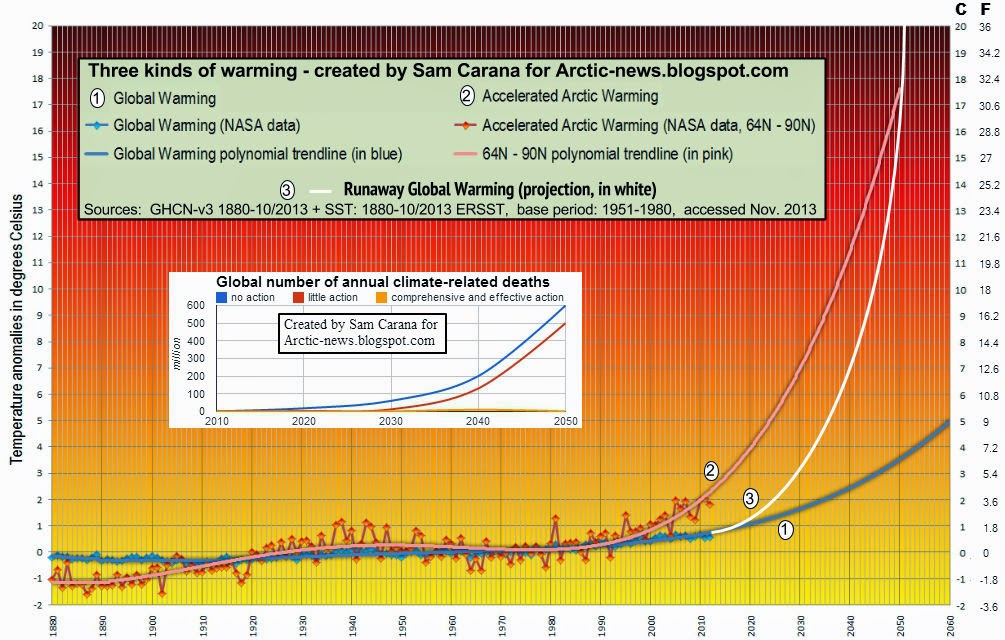
This is further illustrated by the image below, showing how surface temperature rises are accelerating in the Arctic compared to global rises, with trendlines added including one for runaway global warming, from How many deaths could result from failure to act on climate change?
[ click on image to enlarge ]
The situation is dire and calls for comprehensive and effective action, as discussed at the Climate Plan blog.
Hat tip to Jim Kirkcaldy for pointing at the wildfire development at an early stage.
Wildfires can cause a lot of emissions. Obviously, when wood burns, carbon dioxide is emitted into the atmosphere. Wildfires also cause further emissions, such as methane, soot and carbon monoxide. A large part of such emissions can be broken relatively quickly down by hydroxyl, but when large emissions take place, this can take a while. In other words, the lifetime of gases such as methane is extended, particularly in the Arctic where hydroxyl levels are already very low to start with.
Furthermore, the soot that is emitted by such wildfires can settle down on snow and ice, changing its albedo and thus contributing to the demise of the snow and ice cover. As the image shows, soot can be blown high up into the Arctic, depending on the direction of the wind.
Wildfires in Canada and Alaska have now been raging for quite some time. The above image dates back to late last month. Today's images can be quite similar, as illustrated by the two images below.
Smoke from wildfires can travel over quite long distances, as also evidenced by these NASA satellite images showing wildfire smoke crossing the Atlantic Ocean. The relation between wildfire smoke and methane concentrations is further illustrated by the image below.
methane levels July 5, 2013, over 1950 ppb in yellow in 6 layers from 718-840 mb created by Sam Carana with methanetracker.org - sea ice data by SSMIS
Below, a similar image showing methane on the afternoon of July 6, 2013.
methane levels July 6, 2013, over 1950 ppb in yellow, 7 layers from 469-586 mb created by Sam Carana with methanetracker.org - sea ice data by SSMIS
Below, a screenshot created with methanetracker, showing some methane still persisting on July 8, 2013. On the right, the methane originating from the Quebec wildfires appears to have moved farther over the Atlantic Ocean, due to the Coriolis effect. The image also shows some worryingly high methane concentrations in spots above the Arctic sea ice. The spots north of Alaska were also examined in the video at Cruising for methane.
methane levels on the morning of July 8, 2013, over 1950 ppb in yellow, 10 layers from 545 to 742 mb created by Sam Carana with methanetracker.org
Below, a NASA satellite picture showing wildfires in Manitoba, Canada, captured by Terra satellite on June 29, 2013.
NASA image courtesy Jeff Schmaltz, MODIS Rapid Response Team
In conclusion, while carbon pollution gets a lot of attention, the Arctic is also strongly affected by other emissions that can result from wildfires.
The world food situation is deteriorating. Grain stocks have dropped to a dangerously low level. The World Food Price Index has doubled in a decade. The ranks of the hungry are expanding. Political unrest is spreading.
On the demand side of the food equation, there will be 219,000 people at the dinner table tonight who were not there last night. And some 3 billion increasingly affluent people are moving up the food chain, consuming grain-intensive livestock and poultry products.
At the same time, water shortages and heat waves are making it more difficult for farmers to keep pace with demand. As grain-exporting countries ban exports to keep their food prices down, importing countries are panicking. In response, they are buying large tracts of land in other countries to grow food for themselves. The land rush is on.
Could food become the weak link for us as it was for so many earlier civilizations? This slideshow presentation, based on Lester Brown's latest book, Full Planet, Empty Plates: The New Geopolitics of Food Scarcity, explains why world food supplies are tightening and tells what we need to do about it. http://www.earth-policy.org/books/fpep/fpep_presentation