Tampilkan postingan dengan label CH4. Tampilkan semua postingan

Kamis, 20 November 2014

Ocean Temperature Rise Continues


Ocean Temperature Rise

Of all the excess heat that results from people's emissions, 93.4% goes into oceans. Accordingly, the temperature of oceans has risen substantially.

NOAA analysis shows that the most recent 12-month period, November 2013–October 2014, broke the record (set just last month) for the all-time warmest 12-month period in the 135-year period of record. The global oceans were the warmest on record for October. For January–October, the average global sea surface temperature was also record high.


The danger is that ocean temperatures will continue to rise, especially in the North Atlantic, and that the Gulf Stream will keep carrying ever warmer water from the North Atlantic into the Arctic Ocean, threatening to unleash huge methane eruptions from the Arctic Ocean's seafloor, in turn causing even higher temperatures and more extreme weather events, wildfires, etc.


High Methane Levels

High methane levels were recorded over the Arctic Ocean in October, as discussed in this earlier post, and were sustained in November, as discussed in this post. Methane levels as high as 2717 ppb were recorded on November 16, 2014, p.m, by the MetOp-1 satellite at 469 mb (i.e. 19,820 ft or 6,041 m altitude), as the image below shows.

Methane levels as high as 2549 ppb were recorded on November 19, 2014, p.m, by the MetOp-2 satellite at 586 mb (i.e. 14,385 ft or 4,384 m altitude), as the image below shows.

Above image further confirms earlier indications that these high methane levels do indeed result from large methane eruptions from the seafloor of the Arctic Ocean.

Greenhouse gas levels in general are very high over the Arctic, as earlier discussed in a recent post and as illustrated by the image below, showing carbon dioxide levels as high as 420 ppm at high latitudes, while the global mean was 403 ppm, on November 19, 2014, p.m., at 945 mb (i.e. 1,916 ft or 584 m altitude).


As said, sustained instances of large abrupt methane eruptions from the seafloor of the Arctic Ocean threaten to strongly accelerate warming in the Arctic even further, in turn resulting in ever more methane being released, as illustrated in the image below, from an earlier post.


Self-reinforcing Feedback Loops


Such methane eruptions are part of a number of self-reinforcing feedback loops that can strongly accelerate warming in the Arctic. Above image, from an earlier post, illustrates two such feedbacks, i.e. albedo changes due to snow and ice demise, and methane releases. Further feedbacks are described in this post and this post, and in the image below.

For a discussion of these and further feedbacks, see this page at the Climate Plan blog 
The threat is that such rapid temperature rises will appear at first in hotspots over the Arctic and eventually around the globe, while also resulting in huge temperature swings that could result in depletion of supply of food and fresh water, as further illustrated by the above image, from an earlier post, and the image below, from another earlier post.
[ click on image at original post to enlarge ]


IPCC warnings not strong enough


In above paragraph, the IPCC warns about the risk of methane eruptions from the seafloor of the Arctic Ocean further accelerating global warming. While the IPCC does model for a temperature rise that could exceed 12 degrees Celsius in a 'business as usual' scenario (i.e. without action taken), the IPCC does not anticipate that such a rise could occur before the year 2250, as illustrated by the image below.


The situation could be much worse than foreseen by the IPCC, due to a number of reasons, including:
  1. The non-linear way feedbacks can hugely increase temperature rises.
  2.  The IPCC's underestimation of the amount of methane contained in sediments under the Arctic Ocean and prone to be released as temperatures rise. Shakhova et al. estimate the accumulated methane potential for the Eastern Siberian Arctic Shelf (ESAS) alone as follows:
    - organic carbon in permafrost of about 500 Gt;
    - about 1000 Gt in hydrate deposits; and
    - about 700 Gt in free gas beneath the gas hydrate stability zone.
    Back in 2008, Shakhova et al. considered release of up to 50 Gt of predicted amount of hydrate storage as highly possible for abrupt release at any time.
    Furthermore, mantel methane could add to our predicament, as discussed in an earlier post.
  3. Back in 2002, Malcolm Light already warned that seismic events could trigger destabilization of methane hydrates. Furthermore, huge temperature swings can combine with pressure swings and storms, and with swings between expansion and contraction of soil and ice, resulting in severe shocks to ecosystems, as described in an earlier post
  4. The IPCC's ignoring of large methane eruptions from the seafloor of the Arctic Oceans and the resulting growth of mean global methane levels at higher altitudes, as discussed in an earlier post.
Steven Sherwood et al. wrote back in 2010 that peak heat stress, quantified by wet bulb temperature, across diverse climates today never exceeds 31 degrees Celsius (see also this update). Some may believe that this doesn't apply to the Arctic and the higher altitudes in mountain regions. However, at the June Solstice the amount of solar radiation received in the Arctic is higher than anywhere else on Earth, An increased occurence and intensity of heatwaves could expose large areas of the Arctic and mountain regions to sustained heatwaves exceeding peak heat stress temperatures. In addition, ocean acidification and oxygen depletion in the Arctic Ocean would make it hard for fish, seals, polar bears and further wildlife to survive. Furthermore, the short growth season combined with a long, cold winter limits vegetation in the Arctic, while ecosystems are also becoming increasingly exposed to wild weather swings and wildfires.


Risk Assessment

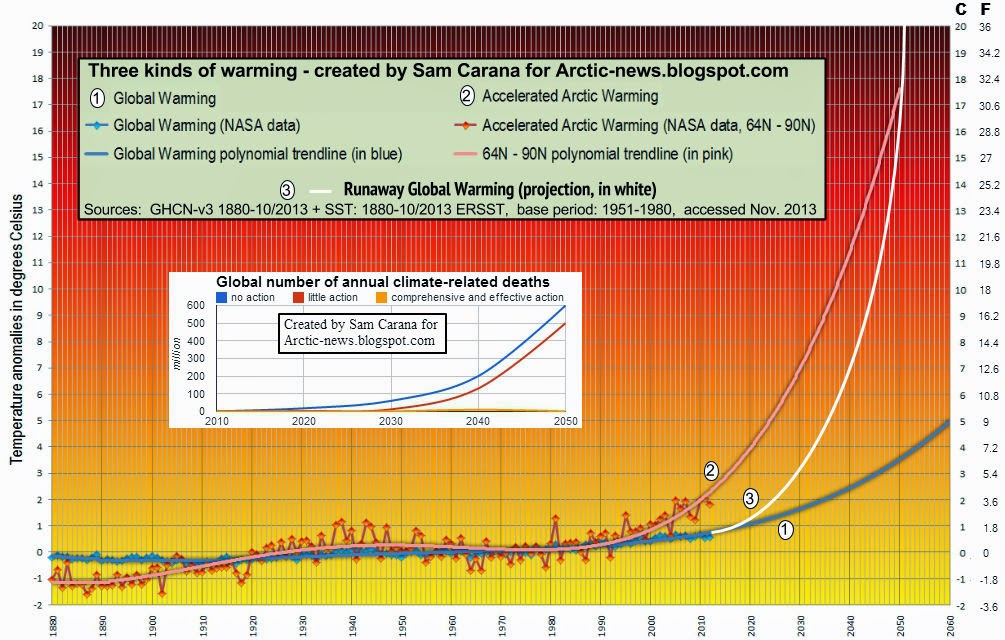
When taking above points into acount, an absence of action seems to guarantee human extinction by the year 2050. Little action will be ‘too little, too late’ and will merely delay human extinction by a few years, as illustrated by the graph below.


The graph identifies the years 2030 and 2040 as critical. Beyond the year 2030, the risk that humans will go extrinct grows larger than 1% in the absence of action. By the year 2040, the risk of human extinction will have increased substantially, especially if no action will have been taken, but also if too little action will have been taken up to 2040, while even with the best possible programs put in place by the year 2015, there will be a 2% risk of human extinction by 2040, e.g. due to war over what action to take, or due to political opposition or errors making such programs ineffective or even counter-productive.

In conclusion, it is highly likely that the risk of human extinction already now is intolerably high and rising with every moment passing with little no action taken to reduce the risk. This calls for comprehensive and effective action, as further discussed at the Climate Plan blog.


References

- Intergovernmental Panel on Climate Change (IPCC) WGI Fifth Assessment Report (AR5), Final Draft (7 June 2013), page 168.
http://www.climatechange2013.org/images/uploads/WGIAR5_WGI-12Doc2b_FinalDraft_Chapter02.pdf

- Intergovernmental Panel on Climate Change (IPCC) WGI Fifth Assessment Report (AR5), Final Draft (7 June 2013), Figure 12.5.
http://www.climatechange2013.org/images/uploads/WGIAR5_WGI-12Doc2b_FinalDraft_Chapter12.pdf

- An adaptability limit to climate change due to heat stress - by Steven C. Sherwood & Matthew Huber
http://www.pnas.org/content/early/2010/04/26/0913352107.full.pdf

- Ocean Temperature Rise - by Sam Carana
http://arctic-news.blogspot.com/2014/10/ocean-temperature-rise.html

- Methane release from the East Siberian Arctic Shelf and the Potential for Abrupt Climate Change - by Natalia Shakhova & Igor Semiletov
http://symposium2010.serdp-estcp.org/content/download/8914/107496/version/3/file/1A_Shakhova_Final.pdf

- Anomalies of methane in the atmosphere over the East Siberian shelf: Is there any sign of methane leakage from shallow shelf hydrates? - by Shakhova, Semiletov, Salyuk & Kosmach  http://www.cosis.net/abstracts/EGU2008/01526/EGU2008-A-01526.pdf

- Mantle Methane - by Malcolm Light
http://arctic-news.blogspot.com/2014/02/mantle-methane.html

- Evidence linking Arctic amplification to extreme weather in mid-latitudes - by Jennifer A. Francis and S.J. Vavrus, in: Geophysical Research Letters 39 (6):. doi:10.1029/2012GL051000
http://onlinelibrary.wiley.com/doi/10.1029/2012GL051000/abstract

- Near-Term Human Extinction - by Sam Carana
http://arctic-news.blogspot.com/2014/04/near-term-human-extinction.html

- Warm waters threaten to trigger huge methane eruptions from Arctic Ocean seafloor - by Sam Carana
http://arctic-news.blogspot.com/2014/08/warm-waters-threaten-to-trigger-huge-methane-releases-from-arctic-ocean-seafloor.html

- How many deaths could result from failure to act on climate change? - by sam Carana
http://arctic-news.blogspot.com/2014/05/how-many-deaths-could-result-from-failure-to-act-on-climate-change.html

- Methane linked to Seismic Activity in the Arctic - by Malcolm P. Light & Sam Carana
http://arctic-news.blogspot.com/p/seismic-activity.html

- Wild Weather Swings - by Sam Carana
http://arctic-news.blogspot.com/2014/10/wild-weather-swings.html

- Four Hiroshima bombs a second: how we imagine climate change - by Sam Carana
http://arctic-news.blogspot.com/2013/08/four-hiroshima-bombs-second-how-we-imagine-climate-change.html

- Polar jet stream appears hugely deformed
http://arctic-news.blogspot.com/2012/12/polar-jet-stream-appears-hugely-deformed.html

- Near-Term Human Extinction
http://arctic-news.blogspot.com/2014/04/near-term-human-extinction.html


Senin, 22 September 2014

350,000 Marchers = 50 Parts Per Million

People's Climate March, New York, September 21, 2014, photo by Cindy Snodgrass

by Nathan Currier

How big a deal was the march in Manhattan yesterday? One of the organizers was 350.org, a group started by Bill McKibben based on a paper by climate scientist James Hansen which stated that we should aim for about 350 parts per million (ppm) CO2. We are currently at about 400ppm, so we need to move "only" about 50ppm in the opposite direction from our rapid growth, which hit a frightening 3ppm clip last year.

It will take a huge effort, and few alive today will live to see it (short of large-scale engineering), but it is interesting to ponder the minute change this represents in the air -- a shift of just 5 one-thousandths of one percent (.005 percent) of the atmosphere! That is one of the fascinating things in climate science, how such a minute change in our atmosphere could potentially have such an impact on the energy balance of our whole planet.

Keep this in mind if you are trying to contemplate how big a deal it is that some 350,000 people came out into the streets of Manhattan, the capital of capitalism, the cultural heart of the nation where manufactured denial has most stymied action. That's because this happens to be exactly the same proportion of the 7 billion members of humanity, 5 one-thousandths of one percent, as that 50ppm is a shift in the composition of the air. Further, some have estimated the real number of marchers as 400,000, and if the global estimates swell equally, then globally about the same proportion were marching as the CO2 growth since industrialization is a shift in atmospheric composition. In a way, all those marching were just a trace, and as soon as we dissipated into streets and subways afterwards, quickly outnumbered by people going about their everyday lives, that seemed obvious, but in another way, how monumental the right little trace can become!

And speaking of powerful little traces, methane is even far less concentrated in the air than CO2, about 220 times less so, but there was really some methane floating around the Manhattan air yesterday! No, I don't mean all those leaky pipes in the city that have led local tests to sometimes register incredibly high ambient readings of the greenhouse gas. I mean that among the marchers anti-fracking signs often seemed to outnumber all other "sub-theme" signs. This is a fascinating phenomenon, as some of us have felt that, since we all ultimately must live in the here and now, and since one cannot impact the climate we have here and now very effectively through CO2 mitigation, yet one can only gain practical political traction by dealing with that here and now, so one of the best ways to gauge seriousness in getting movement going on climate would be to watch for meaningful action on methane. In a sense, if you want people to start climbing up a very steep ladder, you need to give them a nice low first step, and that first climate step would be methane. As Robert Watson, the previous Chair of the United Nation's Intergovernmental Panel on Climate Change put it succinctly, rapidly cutting methane, "would demonstrate to the world that we can do something to quickly slow climate change. We need to get moving to cool the planet's temperature. Methane is the most effective place for us to start."

The Manhattan climate march also provided a fitting example of how getting the big slow march of change rolling can be frustrating: for those in the back it took two hours to start any movement at all, and then another two hours to reach Columbus Circle, its ostensible starting point. Similarly inevitable drags on climate mitigation are making rapid methane action all the more important. And uncertainties in near-term climate change, with a rising potential for high-impact lower-probability events to cause abrupt heating (like non-human methane emissions in the arctic taking off more quickly than models predict), means that ignoring the near-term climate for too long could ultimately prove fatal to all our best intentions. So it's fascinating to see an interest in methane growing from the grass roots, even if it is still largely (and erroneously) confined to the fracking issue at this point. Let's hope that the interest in this merest little trace gas of our air -- since industrialization it has risen by about 1.1 ppm, a shift of about 1.1 ten-thousandth of 1 percent of the atmosphere! -- sparks soon. The group 1250 was initially intended to provide a kind of autonomous offshoot to McKibben's 350, in order to help generate that spark, but McKibben himself soon said that he "had his hands full with CO2" and did not at the time send along to his followers the group's initial petition drive, which then quickly languished. But if methane interest does reach that critical concentration, and that spark is provided, you know what happens next: that's when climate action goes boom.

Above text was earlier posted by Nathan Currier at the HuffingtonPost 

Below follow further photos by Cindy Snowgrass of the People's Climate March.


Senin, 21 Juli 2014

Methane rising through fractures

by Harold Hensel


Methane is colorless and odorless and it is right above us in the atmosphere.

In addition to other sources, methane has traveled from the Arctic and has blanketed most of the Northern Hemisphere.

The well-known sources are methane hydrates from the Arctic Ocean floor and methane coming from thawing permafrost.

There is also another less well-known source. During the geologic history of the Arctic area, tectonic plates have spread, crashed into each other and subducted under one another. Geologists call the Arctic a tectonic plate junkyard. There are numerous fractures in the earth's crust there.

A quote from earth scientist Malcolm Light: ‘Mantle methane formed from the reduction of oceanic carbonates by water in the presence of iron (II) oxides buried to depths of 100 km to 300 km in the Asthenosphere and at temperatures above 1200°C.’ This is a nonorganic source of methane formed near the earth's mantel. Katey Walter Anthony from the University of Alaska calls it geologic methane.

Vast reservoirs of methane have been created by chemical reactions and stored near the mantle under a lot of pressure for millennia.

The methane has had a route to the surface through the fractures in the earth's crust, but the fractures have been sealed over by ice. Now for the first time in human history, the ice sealing the fractures is thawing. Methane is rising through the fractures and into the atmo­sphere. This methane has migrated to the United States and is over us.


Harold Hensel, 
Cedar Rapids.
Earlier published as 
Letter to the Editor 
Cedar Rapids Gazette 
(without images)


Related

- Study: Geologic methane seeping from thawing cryosphere - by Marmian Grimes
http://uafcornerstone.net/study-geologic-methane-seeping-from-thawing-cryosphere

- Focus on Methane - by Malcolm Light
http://arctic-news.blogspot.com/2014/07/focus-on-methane.html

- Arctic Atmospheric Methane Global Warming Veil - by Malcolm Light, Harold Hensel and Sam Carana

- Mantle Methane - by Malcolm Light


Kamis, 05 Desember 2013

The time has come to spread the message

[ click on image to enlarge ]
Above image shows methane rising from the seafloor of the Arctic Ocean on December 3, 2013, and entering the atmosphere, reaching levels as high as 2425 parts per billion (ppb). Last month, on November 9, 2013, methane reached levels as high as 2662 ppb.

The image below gives an idea of the height of this level, compared to historic levels, and how fast levels of methane (CH4) have been rising compared to levels of two other greenhouse gases, i.e. carbon dioxide (CO2) and nitrous oxide (N2O).

While CO2 levels are in ppm and CH4 in ppb, they are directly comparable, in that a CH4 cloud, 5 years after its abrupt
release into the atmosphere over the Arctic Ocean, may have shrunk to 20% of its original size, yet will over those 5 years
have exercized local warming more than 1000 times stronger than the global warming potency of the same mass of CO2.  
Above graph shows the dramatic rise in the levels of greenhouse gases over the past few centuries. Almost half of all global warming results from a 3 Gt rise in methane since the 1750s, as described in the recent post Quantifying Arctic Methane.

Why worry about methane rising from the seafloor in the Arctic? Sediments underneath the Arctic Ocean hold vast amounts of methane. Just one part of the Arctic Ocean alone, the East Siberian Arctic Shelf (ESAS, see map below), holds up to 1700 Gt of methane. A sudden release of just 3% of this amount could add over 50 Gt of methane to the atmosphere, and experts consider such an amount to be ready for release at any time.


Just let those figures sink in for a moment. Total methane burden in the atmosphere now is 5 Gt. The 3 Gt that has been added since the 1750s accounts for almost half of all global warming. The amount of carbon stored in hydrates globally was in 1992 estimated to be 10,000 Gt (USGS), while a more recent estimate gives a figure of 63,400 Gt (Klauda & Sandler, 2005). The ESAS alone holds up to 1700 Gt of methane in the form of methane hydrates and free gas contained in sediments, of which 50 Gt is ready for abrupt release at any time.

Imagine what kind of devastation an extra 50 Gt of methane could cause. Imagine the warming that will take place if the methane in the atmosphere was suddenly multiplied by 11. Whiteman et al. recently calculated that such an event would cause $60 trillion in damage. By comparison, the size of the world economy in 2012 was about $70 trillion.

Smaller releases of methane in the Arctic come with the same risk; their huge local warming impact threatens to further destabilize sediments under the Arctic Ocean and trigger further methane releases, as illustrated by the image below.


Victor Hugo
In the light of these figures, there is no question that this is important and that dramatic changes are needed to reduce such dangers. Indeed, the only question is what kind of changes are needed.

The challenges may seem huge, the opposition to change may seem formidable. Yet despite the saber rattling of armies, and despite covert efforts by powerful conglomarates and vested interests to resist change, common sense will prevail, because nothing is as strong as an idea whose time has come. [“On résiste à l'invasion des armées; on ne résiste pas à l'invasion des idées.” -- From: Histoire d'un crime, Victor Hugo.]

As the prospect of climate catastrophe becomes ever more apparent and as the political imperative to take comprehensive and effective action becomes ever more urgent and obvious, this message will spread and the winds of change will grow stronger day after day. Be part of the solution and spread the message!


Senin, 28 Oktober 2013

Methane over Arctic Ocean is increasing


[ click on image to enlarge ]

Above image shows the Northern Hemisphere on October 26 - 27, 2013, a period of just over one day. Methane readings of 1950 ppb and higher show up in yellow. Peak reading on October 27, 2013, was 2369 ppb.

The image below, created by Harold Hensel with methanetracker, shows methane over the Arctic Ocean in three ranges, with the highest readings (1950 ppb and higher) in red.

[ click on image to enlarge ]
Harold adds: "Methane increased again in the Arctic Circle yesterday, 10/27/2013. So what were the headlines in the news? It wasn't this which is more important than anything the media has to report. This is surreal to me." - at Facebook

Related

- The Unfolding Methane Catastrophe
http://arctic-news.blogspot.com/2013/10/unfolding-methane-catastrophe.html

- Methane hydrates
http://methane-hydrates.blogspot.com/2013/04/methane-hydrates.html

- Myths about methane hydrates
http://methane-hydrates.blogspot.com/p/myths.html

- High Methane Readings continue over Depth of Arctic Ocean
http://arctic-news.blogspot.com/2013/10/high-methane-readings-continue-over-depth-of-arctic-ocean.html

- Abrupt Climate Change
http://arctic-news.blogspot.com/2013/10/abrupt-climate-change.html

- Just do NOT tell them the monster exists
http://arctic-news.blogspot.com/2013/10/just-do-not-tell-them-the-monster-exists.html


Senin, 12 Agustus 2013

Arctic satellite thermal infrared CH4 data compared to surface in-situ and total column measurements

Leonid Yurganov, Senior Research Scientist,
Joint Center for Earth Systems Technology,
University of Maryland Baltimore County


Below an abstract of a paper written by Leonid Yurganov, Xiaozhen Xiong and Ira Liefer, and submitted for presentation at the AGU-Fall meeting 2013.

ABSTRACT: The trace gas sensitivity of Thermal InfraRed (TIR) sounders (AIRS, IASI, TANSO) is greatest in the middle and upper troposphere; though, lower troposphere (1-2 km of altitude) sensitivity is less but not negligible. As a result, where methane largely is constrained to the lower troposphere, as is common in the Arctic particularly the marine Arctic, retrievals from these instruments provides important synoptic data on high latitude methane sources. Low Arctic water vapor content favors a better sensitivity to methane as well: H2O is the main absorber in the 7.8 micrometers spectral region.

Both AIRS/Aqua v6 (NASA) and IASI/Metop-A (NOAA/NESDIS/CLASS retrievals) methane data averaged over 0-4 km altitude clearly demonstrate increased methane concentrations over the Barents and Norwegian Seas (BNS) with seasonal maximum in December - March. Similar increases are observed over the Kara, Laptev, and Chukchi Seas for September-November, i.e. during the period of minimum ice cover over the Arctic (Figures 1 and 2). Comparison of a long series of AIRS data with in situ methane concentrations at the Zeppelin NILU observatory (Svalbard) show good agreement both in amplitude and phase of seasonal variations. Agreement with Barrow NOAA continuous methane in situ data is much worse, which likely results from lower thermal contrast in winter over the cold and icy surfaces of the Eastern Arctic. Further surface validation is by a comparison of total methane columns with the Sun-Tracking FTIR at Ny-Alesund, Svalbard (TCCON network).

These analyses demonstrate that TIR satellites are capable of detecting Arctic methane enhancements from space, particularly over relatively warm year-round water surfaces such as the BNS. Ongoing research is addressing further verification of retrieved methane columns by collecting data with a cavity ring-down spectroscopy analyzer for methane and carbon dioxide on board of the Russian Research Vessel Akademik Fedorov during the expedition NABOS-2013. Data will be collected to measure marine methane concentrations and vertical fluxes between Norway and the Eastern Arctic (New Siberian Islands) between 20 August and 23 September, 2013.

Figure 1

Figure 2. methane concentrations over the Barents and Norwegian Seas (BNS), over the Kara, Laptev, and East Siberian Seas, and over Eurasia (between 50 and 70 degrees North)

Jumat, 09 Agustus 2013

Toward Genuinely Improved Discussions of Methane & Climate

The post 'Toward Improved Discussions of Methane & Climate' recently appeared at SkepticalScience, in response to the recent publication in Nature of 'Vast Costs of Arctic Change', by Gail Whiteman, Chris Hope, and Peter Wadhams.

Below are Paul Beckwith's comments that were recently submitted at that post. The text by SkepticalScience is in italics. Paul's comments are in red.


SkepticalScience: “Here at Skeptical Science, there is an ongoing effort to combat disinformation from those who maintain that climate change is a non-issue or non-reality. From time to time, however, individuals or groups overhype the impacts of climate change beyond the realm of plausibility. Some of this is well-intentioned but misguided. For those who advocate climate literacy or for scientists who engage with the public, it is necessary to call out this stuff in the same manner as one would call out a scientist who doesn’t think that the modern CO2 rise is due to human activities.

Many overblown scenarios or catastrophes seem to involve methane in the Arctic in some way. There are even groups out there declaring a planet-wide emergency because of catastrophic, runaway feedbacks, involving the interplay between high latitude methane sources and sea ice.”


Paul Beckwith: The above two paragraphs set the tone of this discourse. AMEG (Arctic Methane Emergency Group) is unjustly framed in this introduction as a fringe group using such terms as “overhype”, “beyond realm of plausibility”, “overblown scenarios or catastrophes”, “planet-wide emergency”. This is the complete opposite of the truth. AMEG was founded based on a meeting in October, 2011 in the U.K. and I joined in December, 2011. We are a group of concerned professionals with a varied background including climate scientists, engineers, doctors, moviemakers, economists, journalists.

We have studied the Arctic, methane, sea ice, and climate change as a group since that time, and individually for much longer. We base our work and analysis on observations, not on models.

The facts on the ground and ocean in the Arctic region speak for themselves. The PIOMAS work, which has been substantiated independently by CryoSat satellite data, show that the sea ice volume is trending downwards exponentially and if that trend continued would reach zero around 2015 or 2016. Trending down even faster is the May and June Arctic snow cover, as measured clearly by Rutgers data. Methane levels in the Arctic have increased significantly over the last several years. In fact, the mainstream scientific viewpoint was that the seafloor over the ESAS (Eastern Siberia Arctic Shelf) was impermeable to methane outgassing. Then Shakhova, Yurganov, and other Russian scientists measured outgassing plumes tens of meters in diameter one year expanding to kilometers in diameter the very next year. Flask measurements in Barrow, Alaska and Svalbaard indicated local levels of >2100 ppb and AIRS satellite measurements over the last decade have shown greatly increase levels of methane in the last few years. This is all observation, and not modeled by anybody. In fact, higher methane emissions have been reported along the Arctic coastlines, presumably from enhanced wave action due to larger wave action from the increased ice-free ocean.

Also, higher emissions have been measured elsewhere from continental shelves, for example off the east coast of North America from warm Gulf Stream water that has shifted eastward over the shelves, warming ocean temperatures several degrees.

Thus, the “radical” or “fringe” or “out-there” view is not from AMEG, quite the opposite. Based on the precautionary principle, it is imperative that so called “mainstream” science examine this data without preconceptions that it takes centuries or millennia for methane to outgas. It is unfathomable to AMEG and many others that main-stream science are behaving like “methane denialists” when the observations are clearly undermining such out-of-hand rejection, based on inaccurate models that are clearly missing feedbacks. In fact the situation is so ridiculous that the IPCC is not even considering methane as a strong feedback in their next report.

People on the street are now recognizing that the weather extremes are moving off the charts in terms of frequency, severity, and spatial extent (mostly for extensive long duration droughts, and also torrential rains causing floods). They are starting to recognize that the collapse in Arctic albedo from declining snow cover and sea ice loss is greatly amplifying the warming in the Arctic. This obviously lowers the temperature gradient between the equator and North Pole which via simple physical laws slows the jet streams making them wavier and stickier. This changing global circulation, combined with 4% higher water vapor in the atmosphere is causing these weather extremes.

Things are happening that have never been observed before in human history. Like the rate of decline of sea ice and snow cover, the extensive cracking of sea ice this March-2013, the “hole” forming near the north pole from relatively weak cyclones, the massive, long duration cyclone at the beginning of August-2012, and the list goes on and on. AMEG being extreme? Hardly, more like science compartmentalization and specialization being myopic to the collection of system changes that are screaming out that the climate system has entered a period of abrupt change that has not been seen before in human history, but has happened many times in the paleorecords. In fact, rates of change now are at least 10x higher than any seen in the geologic record.


SkepticalScience: About a week ago, a Nature article by Gail Whiteman, Chris Hope, and Peter Wadhams came out analyzing the "Vast Costs of Arctic Change." The Whiteman article is an honest and thoughtful commentary about the economic impacts of a changing Arctic climate. I will not comment on their economic modeling here, but rather on a key scenario assumption that they use which calls for vast increases in Arctic-sourced methane to the atmosphere. In this case, they have in mind a very rapid pulse of 50 Gigatons of methane emanating from the East Siberian Shelf (see image, including Laptev and East Siberian sea). Note: 1 GtCH4= 1 Gigaton of methane = 1 billion tons of methane. Whiteman et al. essentially assume that this "extra methane" will be put in the atmosphere on timescales of years or a couple decades. This article has been widely publicized because it calls for an average of 60 trillion dollars on top of all other climate change costs. Since this was discussed in a prediction context rather than as a thought experiment, it demands analysis of evidence.

In this article, I will argue that there is no compelling evidence for any looming methane spike. Other scientists have spoken out against this scenario as well, and I will encompass some of their arguments into this piece. In summary, the reason a huge feedback is unlikely is because of the long timescale required for global warming to reach some of the largest methane hydrate reservoirs (defined later) 
(Paul Beckwith: no methane was expected from ESAS since seafloor was thought to be impermeable, until it was measured to rapidly outgas from one year to the next), and because no evidence exists for such an extreme methane concentration sensitivity to climate in the past record (Paul Beckwith: methane pulses released over several years or a few decades is not detectable in ice cores since bubble closure below firn takes about 50 years or more).Permafrost feedbacks are of concern, but there is no basis for assuming a dramatic "tipping point" in the atmospheric methane concentration (Paul Beckwith: no basis for this statement since observations show large increase in methane).

The Methane Tour

Methane (CH4) is a greenhouse gas. It absorbs thermal energy that the Earth is trying to shed into outer space, and can thus warm the surface of the planet. Its concentration in the modern atmosphere is a little bit shy of 2 parts per million by volume (ppm), compared to roughly 0.72 ppm in 1750 or 0.38 ppm in typical glacial conditions. Like CO2, methane has not risen to modern day concentrations during the entirety of the now ~800,000 year long ice core record.

So what about Whiteman's scenario?

For perspective on how big 50 GtCH4 is, I've used data from David Archer's online methane model to see how atmospheric methane concentrations would change in response to such a big carbon injection. You can do this as a back-of-envelope calculation by noting that 1 ppm is about 2.8 GtCH4 if it all stays as methane and isn't removed, but this model lets you see the decay timescale too. For methane, the decay back to original concentrations occurs within decades, whereas for CO2 it takes millennia (CH4 is rapidly oxidized by the hydroxyl radical in the atmosphere). Therefore, CO2 dominates the long-term climate change picture but the methane spike can induce very large transitory effects.
(Paul Beckwith: keep in mind that the methane lifetime varies greatly depending on the availability of the hydroxyl radical. On average it is 12 years, however in dry regions like the Arctic with little water vapor it is longer, while at moist equatorial regions it is shorter).

I've run two scenarios in which the 50 GtCH4 injection takes 1 year and 10 years to complete (red and blue lines, respectively). The model starts with pre-industrial CH4 concentrations in years -10 through zero. The modern concentration of methane is shown as a horizontal orange line.


Everything having to do methane in the ice core record resides below the orange line in Figure 1 (at least within the resolution of the cores). So we're potentially talking about a very big change, which the Whiteman article contends is likely to be emitted fairly soon and should have implications for Arctic policy. (Paul Beckwith: This graph clearly demonstrates that if glacial ice bubble closure takes 50 years, then the pulse will not be captured. Also, the molecular weight of CH4 is 16 compared to 30 or so for air (mostly N2) so the methane does not stay around the surface for long).

For many, the primary concern about “big” abrupt changes in atmospheric CH4 stems from the large quantity of CH4 stored as methane hydrate or in permafrost in the Arctic region. These terms are defined below. It should be noted that globally, wetlands are the largest single methane source to the modern atmosphere. Most of that contribution is from the tropics and not from high latitudes (even if the Arctic was to start pumping harder). The Denman et al., 2007 carbon cycle chapter in the last IPCC report is a useful reference. (Paul Beckwith: methane from wetlands in tropics has short lifetime due to extremely large quantities of water and thus hydroxyl ions in that region, as opposed to methane from the Arctic in much drier conditions)

Nonetheless, the Arctic is a region that is quite dynamic and is changing rapidly. The high latitudes are currently a CO2 sink (Paul Beckwith: this cannot be correct, since CO2 concentrations are higher in the Arctic than the global values measured at Mauna Loa, for example) and CH4 source in the modern atmosphere, and it’s not implausible that the effectiveness of the sink could diminish (or reverse) or that the methane source could enhance in the future, since we expect a transition to a warmer, wetter climate with an extended thawing season. This makes the carbon budget in the Arctic a “hot” place for research.

In these discussions, it is important to clarify what sort of methane source we're talking about.

Methane hydrate is a solid substance that forms at low temperatures / high pressures in the presence of sufficient methane. It is an ice-like substance of frozen carbon, occurring in deep permafrost soils, marine continental margins, and also in deeper ocean bottom sediments. It's also very concentrated (a cubic foot of methane hydrate contains well over 100 times the same volume of methane gas).

On the decade-to-century timescale, the liberation of methane from the marine hydrate reservoir (or the deep hydrates on land) should be well insulated from anthropogenic climate change. Deep ocean responses by methane are a very slow response (many centuries to millennia, Archer et al., 2009). Methane released in deep water also needs to evacuate the water column and get to the atmosphere in order to have a climate impact, although much of it should get eaten up by micro-organisms before it gets the chance. These issues are discussed in a review paper by O’Connor et al., 2010.
(Paul Beckwith: Methane response in deep ocean is not always slow, thus this section is very misleading. Underwater landslides from slope instability or earthquakes are know to have resulting in large methane pulses many times in the paleorecords. For example, Storegga off Norway or off New Zealand, there are extensive pockmarks on the ocean floor indicating abrupt episodic events. The mainstream view that methane outgassing from deep water regions does not enter the atmosphere. If release is slow that is correct, however rapid outbursts overwhelm the micro-organisms and result in large amounts of methane entering the atmosphere. Even slower releases from deep water off Svalbard have been observed recently to enter the atmosphere; another unexpected development).

There’s also carbon in near-surface permafrost, which is the more vulnerable carbon pool during this century. Permafrost is frozen soil (perennial sub-0°C ground), and can also encompass the sub-sea permafrost on the shelves of the Arctic Ocean. This includes the eastern Siberian shelf, a very shallow shelf region (only ~10-20 m deep, and very broad, extending a distance of 400– 800 km from the shoreline). This is a bit of a special case. These subsea deposits formed during glacial times, when sea levels were lower and the modern-day seafloor was instead exposed to the cold atmosphere. The ground then became submerged as sea levels rose (going into the warmer Holocene). The rising seas have been warming the deposits for thousands of years. Because of their exposure during the Last Glacial Maximum, the shelves may be almost entirely underlain by permafrost from the coastline all the way down to a water depth of tens or even a hundred meters (e.g., Rachold et al., 2007 and this USGS page).

There's actually no good evidence of shallow hydrate on the Siberian shelves, even though there are substantial quantities of subsea permafrost. Hydrate may exist deeper down however, more than 50 meters below the seafloor. The stability of these hydrates is sustained by the existence of permafrost, and it's not quite clear to what extent hydrate can also be stored within the permafrost layer.
(Paul Beckwith: Permafrost people have an over-reliance on uniform slab models which examine time taken for heat to propogate through the slabs to melt the deep permafrost. They severely underestimate the fracturing and nonuniform nature of the permafrost, presence of taliks, etc. All that is needed is one weak spot or fracture region and heat can transfer downward much faster and further than the models suggest. Similar slab models are used to estimate glacial ice melting and they have clearly been incorrect and completely underestimate the rates of melting from dynamic effects and Moulin pathways, for example.)

The estimates of the amount of methane in these various Arctic reservoirs are very uncertain. Ballpark numbers are a couple thousand gigatons of carbon (GtC) stored in hydrates in global marine sediments (e.g., Archer et al., 2009) of which a couple hundred gigatons of carbon are in the Arctic Ocean basin, and between 1000-2000 GtC in permafrost soil carbon stocks (e.g., Tarnocai et al., 2009) after you include the deeper deposits. For comparison, there is a bit over 800 GtC in the atmosphere, of which about 5 Gt is in the form of methane, and estimated ~5000 GtC in the remaining fossil fuel reserve. These numbers seem big compared to the atmosphere, but for methane direct comparison isn't too relevant unless you put it in rapidly, since it has such a short lifetime in the atmosphere. Large amounts of CO2, in contrast, last much longer.

A couple years ago, Shakhova et al. (2010a) reported extensive methane venting in the eastern Siberian shelf and suggested that the subsea permafrost could become unstable in a future warmer Arctic. Shakhova et al (2010b) cite ~1400 Gt in the East Siberian Arctic Shelf, which comprises ~25% of the Arctic continental shelf and most of the subsea permafrost. Shakhova et al (2010c) ran through a few different pathways in which they argued for 50 GtCH4 release to the atmosphere either in a 1-5 year belch or over a 50-yr smooth emission growth, which they suggest, “significantly increases the probability of a climate catastrophe.” This assessment was the foundation for the concern in the recent Whiteman Nature article, linked at the top.

The physical mechanism outlined by some of these authors is related to the rapid reduction in Arctic summer sea ice observed over the last few decades, which allows for greater amounts of solar radiation to penetrate the waters around the Arctic shelf. Warming water propagates down in the well-mixed layers tens of meters to the seabed, and might melt frozen sediments underneath. Because the shelf in this region is shallow (compared to other regions), one doesn't need to wait a long time for the seafloor to feel the atmosphere-surface forcing, and methane leakage might have an easier escape path to the atmosphere. Allegedly, this has been leading to an acceleration of methane flux.


Responses from Scientists

As a response to the first paper from Shakhova on enhanced methane fluxes, Petrenko et al (2010) criticized the authors for misunderstanding several of their references and primarily for the logical implications of their conclusions. For example,
“A newly discovered CH4 source is not necessarily a changing source, much less a source that is changing in response to Arctic warming. Shakhova et al. do acknowledge these distinctions, but in these times of enhanced scrutiny of climate change science, it is important to communicate all evidence to the scientific community and the public clearly and accurately”
(Paul Beckwith: Examination of the methane concentrations in the atmosphere in the Arctic region from AIRS satellite data over a decade or so shows an obvious large increase in the amount of methane, and has been corroborated with flask measurements at locations across the Arctic, namely Barrow, Alaska and Svalbard. How is this not a changing source?)

Another paper, Dmitrenko et al (2011) reinforced this statement and came to the conclusion that there is currently no evidence that Arctic shelf hydrate emissions have increased due to global warming. This is also discussed in the review article by O'Connor et al (2010, linked above). (Paul Beckwith: Again, does one trust a direct observation or a conclusion from a paper? Obviously the direct observation.)

The work done by the Dmitrenko paper shows that although the changing Arctic atmosphere has led to warmer temperatures throughout the water column (over the eastern Siberian shelf coastal zone), it takes a very long time for the permafrost feedback at the bed to respond to this signal. They noted that the deepening of the permafrost table should only have been on the order of 1 meter over the last several decades, which does not permit a rapid destabilization of methane hydrate.  (Paul Beckwith: Deepening of the permafrost table of 1 meter over several decades is based on a slab model and let to the erroneous mainstream view that the seafloor over the ESAS was impermeable to methane release. Measurements show otherwise.)

It is important to emphasize that simple point source emission estimates are not often suitable for determining changed sources and sinks over the last few decades, and thus don't tell you how that translates into atmospheric concentration. This should be kept in mind when seeing dramatic videos of methane venting from a shelf or exploding lake, which might not actually have much to do with global warming. (Paul Beckwith: This is a very alarming view, and would fit in fine on any of numerous climate denial websites. Rapid methane emissions in the Arctic are what they are. Call a spade a spade.)

In 2008, there was a comprehensive report on Abrupt Climate Change from the U.S. Climate Change Science Program, which is a bit dated but nonetheless makes a statement reflecting most of current scientific thinking. Quoting Ch. 5 Brook et al (2008):
"Destabilization of hydrates in permafrost by global warming is unlikely over the next few centuries (Harvey and Huang, 1995). No mechanisms have been proposed for the abrupt release of significant quantities of methane from terrestrial hydrates (Archer, 2007). Slow and perhaps sustained release from permafrost regions may occur over decades to centuries from mining extraction of methane from terrestrial hydrates in the Arctic (Boswell, 2007), over decades to centuries from continued erosion of coastal permafrost in Eurasia (Shakova [sic] et al., 2005), and over centuries to millennia from the propagation of any warming 100 to 1,000 meters down into permafrost hydrates (Harvey and Huang, 1995)" (Paul Beckwith: Again, slab model thinking. Episodic events like landslides negate these claims, as does fractures and other weakspots in the slabs which allow pathways for huge heatflow. A good analogy is polyanas in sea ice that allow for enormous heat flow between the ocean and the atmosphere in a sea ice field.)
Paleo-Analogs

One of the primary reasons we don't think there's as much methane sensitivity to warming as has been proposed by Shakhova, and argued for in the Whiteman Nature article, is because there's no evidence for it in the paleoclimate record.  This has been a point made by Gavin Schmidt on Twitter (a compilation of his many tweets on the topic here) but the objections to the Nature assumptions have been further echoed in recent days by other scientists working on the Arctic methane issue (e.g., here, here).

One can argue from a process-based and observations-based approach that we don't understand everything about Arctic methane feedback dynamics, which is fair. Nonetheless, the methane changes on the scale being argued by Whiteman et al. should have been seen in the early Holocene (when Summer Northern Hemispheric solar radiation was about 40 W/m2 higher than today at 60 degrees North, 7000-9000 years ago). (Paul Beckwith: Earth tilt was larger, so Winter Northern Hemispheric solar radiation was about 40 W/m2 lower than today at 60 degrees North. Thus, the ice formed much more quickly and much thicker in the winter back then. Also, at night much more heat was radiated out to space in the lower GHG world then as compared to our 400 ppm levels today). Even larger anomalies occurred during the Last Interglacial period between 130,000 to 120,000 years ago, though with complicated regional evolution (Bakker et al., 2013). 

Both of these times were marked by warmer Arctic regions in summer without a methane spike. It's also known pretty well (see here) that summertime Arctic sea ice was probably reduced in extent or seasonally free compared to the modern during the early Holocene, offering a suitable test case for the hypothesis of rapid, looming methane release. (Paul Beckwith: Incorrect, the summertime Arctic is not believed to be seasonally ice free during these periods. The last time this happened was likely 2 or 3 million years ago.)

It should be noted that Peter Wadhams did offer a response recently to the criticisms of the Whitehead Nature piece (Wadham is a co-author) but did not address why this idea has not been borne out paleoclimatically.

Yesterday, an objection to the paleoclimate comparison cropped up in the Guardian suggesting that the early Holocene or Last Interglacial analogs are not suitable pieces of evidence against rapid methane release. They aren't perfect analogs, but the argument does not seem compelling. (Paul Beckwith: Colder winters in the early Holocene and Last Interglacial and much colder nights (in summers and winters then) meant much thicker and extensive ice formation in winters, and slower melting at night, respectively. Compelling arguments.) The Northeast Siberian shelf regions have been exposed many times to the atmosphere during the Pleistocene when sea levels were lower (and not covered by an ice sheet since at least the Late Saalian, before 130,000 years ago, e.g., here). As mentioned before, when areas such as the Laptev shelf and adjacent lowlands were exposed, ice-rich permafrost sediments were deposited. The deposits become degraded after they are submerged (when sea levels increase again), resulting in local flooding and seabed temperature changes an order of magnitude greater than what is currently happening. Moreover, the permafrost responses have a lag time and are still responding to early Holocene forcing (some overviews in e.g., Romanovskii and Hubberten, 2001; Romanovskii et al., 2004; Nicolsky et al., 2012). A book chapter by Overduin et al., 2007 overviews the history of this region since the Last Glacial Maximum. These texts also suggest that large amounts of submarine permafrost may have existed going back at least 400,000 years. It therefore does not seem likely that the seafloor deposits will be exposed to anything in the coming decades that they haven't seen before. (Paul Beckwith: What is unique now is the extremely high concentration levels of CO2 (400ppm) and CH4 (>1900ppb). These high concentrations trap the heat in the troposphere 24/7. Thus, at night heat loss is limited by the GHG blanket. At all previous times the GHG blanket was much weaker, with CO2 ranging from 180 to 280 ppm and CH4 ranging from 350 to 700 ppb, or so. This makes an enormous difference.)

What about other times in the past? Fairly fast methane changes did occur during the abrupt climate change events embedded within the last deglaciation (e.g., Younger Dryas), just before the Holocene when the climate was still fluctuating around a state colder than today. These CH4 changes were slower than the abrupt climate changes themselves, and have been largely attributed to tropical and boreal wetland responses rather than high latitude hydrate anomalies. Marine hydrate destabilization as a major driver of glacial-interglacial CH4 variations has also been ruled out through the inter-hemispheric gradient in methane and hydrogen isotopes (e.g., Sowers, 2006(Paul Beckwith: Episodic events like landslides, as mentioned before, cannot be discounted. In fact geological events like landslides occur at much higher frequencies when there is a rapid temperature transition, as covered extensively in Bill McGuire’s new textbook. Also, the text on “The Clathrate Gun hypothesis” cannot be completely discounted.)

To be fair, we don't have good atmospheric methane estimates during warmer climates that prevailed beyond the ice core record, going back tens of millions of years. Methane is brought up a lot in the context of the Paleocene-Eocene Thermal Maximum (PETM, 55 million years ago). During this time, proxy records show global warming at the PETM (similar to what modern models would give for a quadrupling of CO2), extending to the deep ocean and lasting for thousands of years. In addition, there were substantial amounts of carbon released. It may very well be that isotopically light carbon came from a release of some 3,000 GtC of land-based organic carbon, rather than a destabilization of methane hydrates, although this is a topic of debate and ongoing research (see e.g., Zeebe et al., 2009; Dickens et al., 2011).

It's also important to emphasize that any destabilization of oceanic methane hydrates at the PETM, or any other time period, would imply that the carbon release is a feedback to some ocean warming that occurred first- perhaps on the order of 1000 years beforehand. Furthermore, once methane was in the atmosphere, it would oxidize to CO2 on timescales significantly shorter than the PETM itself (decades.) Unfortunately, there is no bullet-proof answer right now for what caused the PETM, but rather several hypotheses that are consistent with proxy interpretation. However, methane cannot be the only story.

The Role of Methane in Climate (Change)

To be clear, CH4 is important as we go forward, and is already a key climate forcing agent behind CO2 (coming in at ~0.5 W/m2 radiative forcing since pre-industrial times). Additionally, methane is quite reactive in the atmosphere, and the effect of other things like tropospheric ozone, aerosols, or stratospheric water vapor are partly slaved to whatever is happening to methane (Shindell et al., 2009). This means methane emitted has a bigger collective impact on climate than if you just do the radiative forcing calculation by comparing methane concentration changes to what it was in 1750.
 (Paul Beckwith: It is important to point out an enormous misconception in public and scientific reports on methane regarding the Global Warming Potential (GWP). A number in the low 20s is almost always reported (22x, 25x…) and is based on a 100 year timescale. On a 20 year timescale, methane GWP is around 70x, and on a 1 or 2 year timescale the GWP is >150x. Clearly, in terms of methane in the Arctic sourced from marine or terrestrial permafrost the number of significance to sea ice and localized warming is 150x.)

Permafrost thawing is also going to be important in the coming century (this is a good paper), and the uncertainties pretty much go one way on this. There's not much wiggle room to argue that permafrost will reduce CH4/CO2 concentrations in the future. This is also likely to be a sustained release rather than one big catastrophic event. For example, permafrost was not included in Lenton (2008) as a "tipping point" for precisely the reason that there's no evidence for any "switch" of rapid behavior change. (Paul Beckwith: Exclusion of methane as a “tipping element” in this paper by the “experts” in 2008 was based on rates of change based on slab models, which recent observations of emissions has clearly invalidated). Much of the carbon is also likely to be in the form of CO2 to the atmosphere, and even implausible thought experiments of catastrophic methane release (see David Archer's post at RealClimate) give you comparable results in the short-term as to what CO2 is going to do for a long time.

Conclusion

The observed methane venting from the East Siberian shelf sea-floor to the atmosphere is probably not a new component of the Arctic methane budget. Furthermore, warming of the Arctic waters and sea ice decline will likely impact subsea permafrost on longer timescales, rather than the short term. (Paul Beckwith: Is this author so sure of this as to be willing to stake the stability/instability of the entire global circulation system on this?)

Methane feedbacks in the Arctic are going to be important for future climate change, just like the direct emissions from humans. This includes substantial regions of shallow permafrost in the Arctic, which is already going appreciable change. Much larger changes involving hydrate may be important longer-term. Nonetheless, these feedbacks need to be kept in context and should be thought of as one of the many other carbon cycle feedbacks, and dynamic responses, that supplement the increasing anthropogenic CO2 burden to the atmosphere. There is no evidence that methane will run out of control and initiate any sudden, catastrophic effects. (Paul Beckwith: There is no evidence that methane will not run out of control, in light of large increases of concentrations in recent years).  There's certainly no runaway greenhouse. Instead, chronic methane releases will supplement the primary role of CO2. Eventually some of this methane oxidizes into CO2, so if the injection is large enough, it can add extra CO2 forcing onto the very long term evolution of global climate, over hundreds to thousands of years.


Errata Update SkepticalScience: Gavin Schmidt let me know that in the first version of this post, I used gigatons of carbon instead of gigatons of methane. I mistakingly read the Shakhova paper as an injection of carbon. Since the molecular weight of carbon is 12 g/mol, and CH4 is 16 g/mol, then 1 GtC=1.33 GtCH4. The figure in the post has been revised accordingly and doesn't impact the argument here.


Related

- Arctic Methane Release: "Economic Time Bomb"
http://arctic-news.blogspot.com/2013/07/arctic-methane-release-economic-time-bomb.html

- Methane Hydrates
http://methane-hydrates.blogspot.com/2013/04/methane-hydrates.html

- Arctic Methane FAQ
http://arcticmethane.blogspot.com/p/faq.html


- Listen to Paul Beckwith speak on Gorilla-radio.com
http://www.gorilla-radio.com/audio/Gorilla_Radio_2012-2013-08-13-24647.mp3