Tampilkan postingan dengan label disaster. Tampilkan semua postingan

Senin, 04 Agustus 2014

No U.S. - Russia Nuclear Defense For Real-Life ‘Armageddon’ Asteroid Threats


U.S.—Russia Tensions Nuke Plans For Real-Life ‘Armageddon’ Asteroid Defense -- Asawin Suebsaeng, Daily Beast

The U.S. Energy Department, apparently, is being forced to close its eyes.

Rising tensions between the United States and Russia, stemming from the latter’s recent aggressions, have upended the Obama administration’s ambitious Russia “reset”—and with it, the once-promising U.S.-Russian plans to destroy killer asteroids with nuclear bombs.

On Sunday, The New York Times ran a story detailing how the Ukraine crisis has stalled an accord that promised “one of the most expansive collaborations ever between the countries’ nuclear scientists, including reciprocal visits to atomic sites to work on projects ranging from energy to planetary defense.” Some of those plans for planetary defense sound like they were ripped right out of a Michael Bay movie.

Via the NY Times:

Read more ....

My Comment: If a killer asteroid is heading our way .... I am confident that the U.S. and Russia will find a way to quickly solve their differences.

Sabtu, 02 Agustus 2014

How A Solar Superstorm Could Destroy The Earth


Apocalypse NOW: Killer Solar Superstorm Could Destroy Earth At ANY MOMENT, Scientists Warn -- Express.co.uk 

VIOLENT solar superstorms could destroy life as we know it at ANY MOMENT, shocked scientists have warned today.

It is “only a matter of time” before a catastrophic eruption on the surface of the sun hurtles towards the planet with devastating consequences.

The Earth could be the target of an explosion equivalent to “10 billion Hiroshima bombs exploding at the same time”.

It has emerged crisis meetings have been held to discuss how to limit the damage of solar superstorms which present a “long-lasting” threat to all forms of life.

Scientists warn communication systems will be crippled, vital services such as transport, sanitation and medicine will close, and loss of power will plunge the planet into darkness.

Read more ....

My Comment: I love these doom and gloom reports. But in the event of a solar super storm .... it will be safe to assume that I will not be blogging if the worse case scenario does unfold.

Sabtu, 15 Februari 2014

Extreme weather strikes around the globe - update

As the weather gets more extreme, disaster strikes around the globe. The Guardian reports three people killed as storms continue to batter southern UK. The Vancouver Sun reports that a U.S. Northeast snowstorm kills 25. And the Sacramento Bee reports Six dead and 1,000 injured in fresh Japan snow storm.

What is the story behind these extreme weather events? The image below tells the story. The Arctic has been much warmer than it used to be, due to numerous feedbacks that accelerate warming in the Arctic. This reduces the temperature differential between the Arctic and lower latitudes, which changes the Jet Stream and Polar Vortex, in turn making the weather at many places ever more extreme.

 earlier forecasts by cci-reanalyzer.org
Above image illustrates the situation, showing an Arctic Ocean that is warmer than the higher latitudes of the Asian and North American continents.

Arctic sea ice has meanwhile reached record lows, as illustrated by the image below.


The situation can be expected to get even worse. The image below shows sea ice extent, as measured by the NSIDC, which is one day ahead compared to above image.


Below, two regular contributors to the Arctic-news blog comment on the situation.


    Paul Beckwith:

Paul Beckwith with sign (arrows highlighted by Sam Carana, from earlier post)
In the video below, Paul Beckwith discusses the above sign and the situation in general.


Dr. Malcolm Light, Earth Scientist, comments:


The volume of water transported by Gulf Stream off the east coast of the United States has increased by three times since the 1940s due to a massive increase in wind drag. This increase in the south westerly wind drag is a result of the continuously increasing pressure difference set up between the continental air mass over North America, heated by fossil - fuel generated carbon dioxide, and the marine air of the Atlantic.

The increased energy entering the Gulf Stream as heat and its associated winds and storm systems are what are now pummeling Great Britain and Europe. This heat is also transported further north by branches of the Gulf Stream into the Arctic Ocean, where it is destabilizing the subsea methane hydrates, releasing increasing volumes of methane into the Arctic atmosphere and causing temperature anomalies this last winter of more than 20 degrees Celsius.

As a consequence of the extremely high Arctic temperatures and pressures, the normal freezing Arctic air has been displaced into Canada and the United States, causing catastrophic blizzards that have never been seen before. When the floating Arctic ice cap melts towards the end of next year, the Arctic Ocean will then become more aggressively heated by the sun and the northern offshoots of the Gulf Stream.

Under these circumstances, the cold Arctic air will be confined over the Greenland ice cap and the Arctic atmosphere will rotate anticlockwise around Greenland, transferring the fast-increasing amounts of its atmospheric methane to Canada and the United States and causing a further increase in the energy of the Gulf Stream.

Therefore the United Kingdom and Europe must brace themselves for even more catastrophic weather systems, widespread flooding and massive wind damage from the start of the last quarter of next year.


Below is a comparison of methane readings for the week from February 9 to 16, 2014, compared to the same period in 2013.


The comparison shows that there is a lot of methane over the Arctic Ocean that wasn't there last year. Furthermore, high methane readings show up where currents move the sea ice out of the Arctic Ocean, in areas such as Baffin Bay. This indicates that methane that is released from the seafloor of the Arctic Ocean appears to be moving underneath the ice and entering the atmopshere where the sea ice is fractured or thin enough to allow the methane to pass through.

Also note that more orange areas show up on the southern hemisphere in 2014, indicating that more methane from the northern hemisphere is now spreading south beyond the equator. This in addition to indications that more methane is rising and building up at higher altitudes, as discussed in an earlier post.

As said before, the situation calls for comprehensive and effective action, as discussed at the Climate Plan blog.


Senin, 10 Februari 2014

Extreme weather strikes around the globe

  Editorial note: this post has meanwhile been updated as
Extreme weather strikes around the globe update.


As the weather gets more extreme, disaster strikes around the globe.

Here's a snapsnot from today's news. In London, the BBC reports, flooded homes along the River Thames are being evacuated and thousands more are at risk. In Japan, reports Reuters, eleven people died, more than a thousand were injured and tens of thousands lost power when the worst snowstorm in decades hit Tokyo and areas around the Japanese capital before heading north to blanket the tsunami-hit Pacific coast. Many countries in the Middle East were hit by snow. The BBC reports that heavy snow in northern Iran has left around 480,000 homes without power and some towns and villages cut off.

What is causing these extreme weather events? The image below tells the story. While at times it has been cold at many places around the world, when averaged over the past 30 days, temperatures around the globe have actually been several degrees higher than they used to be. The Arctic has been hit hardest, with anomalies as high as 21°C over this 30 day period. This affects the Jet Stream and Polar Vortex, which in turn is making the weather ever more extreme.


The situation is further illustrated by the cci-reanalyzer.org forecasts below.


And while the sea ice didn't look too bad at the start of the year, growth has meanwhile stopped, as illustrated by the image below.


Added below are two videos by Paul Beckwith, further discussing the situation.


Editor's note: Reanalysis of temperature anomaly Jan 12 - Feb 10, 2014.
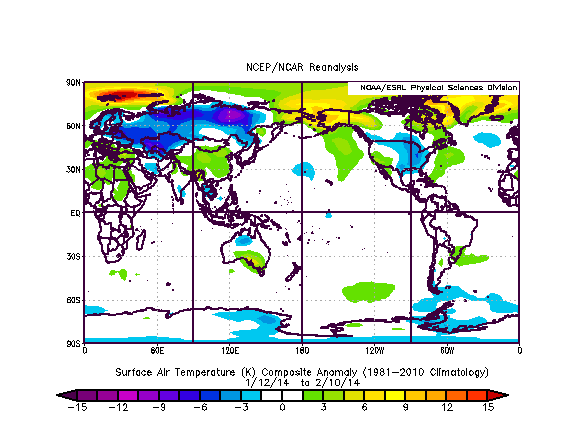
Meanwhile, I've added another image (above), created with NOAA's reanalysis, which compares temperatures to a larger dataset, and the colors look a lot different, so NOAA may indeed have mixed the colors up somewhat in the initial image, as Albert suggested at the Facebook discussion (click on image below).

Anyway, the point made in the post remains, i.e. that as global warming continues, warming in the Arctic accelerates more rapidly than at lower latitudes, which weakens the polar vortex and jet stream in a self-reinforcing feedback that causes the Arctic to warm up even further compared with lower latitudes.

As said, the situation calls for comprehensive and effective action, as discussed at the Climate Plan blog.