Tampilkan postingan dengan label drought. Tampilkan semua postingan

Sabtu, 31 Mei 2014

How many deaths could result from failure to act on climate change?

A recent OECD study concludes that outdoor air pollution is killing more than 3.5 million people a year globally. The OECD estimates that people in its 34 Member countries would be willing to pay USD 1.7 trillion to avoid deaths caused by air pollution. Road transport is likely responsible for about half.

A 2012 report by DARA calculated that 5 million people were dying each year from climate change and carbon economies, mostly from indoor smoke and (outdoor) air pollution.

Back in 2012, a Reuters report calculated that this could add up to a total number of 100 million deaths over the coming two decades. This suggests, however, that failure to act on climate change will not cause even more deaths due to other causes.

Indeed, failure to act on climate change could result in many more deaths due to other causes, in particular food shortages. As temperatures rise, ever more extreme weather events can be expected, such as flooding, heatwaves, wildfires, droughts, and subsequent crop loss, famine, disease, heat-stroke, etc.

So, while currently most deaths are caused by indoor smoke and outdoor air pollution, in case of a failure to act on climate change the number of deaths can be expected to rise most rapidly among people hit by famine, fresh water shortages, as well as wars over food, water, etc.

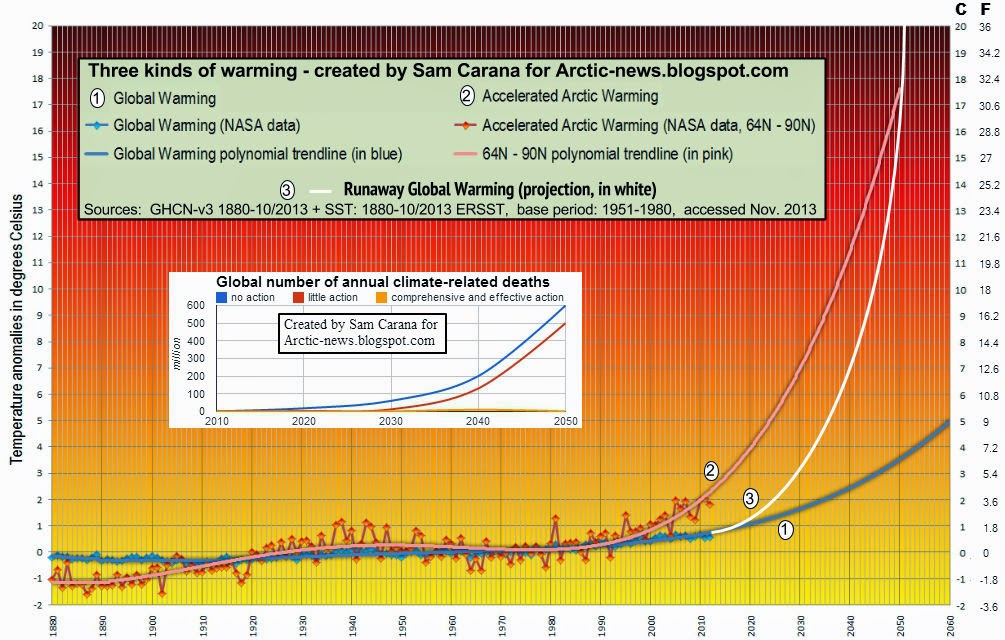
How high could figures rise? Below is an update of an image from the earlier post Arctic Methane Impact with a scale in both Celsius and Fahrenheit added on the right, illustrating the danger that temperature will rise to intolerable levels if little or no action is taken on climate change. The inset shows projected global number of annual climate-related deaths for these two scenarios, i.e. no action and little action, and also shows a third scenario of comprehensive and effective action that would instead bring temperature rise under control.

[ click on image to enlarge ]
For further details on a comprehensive and effective climate plan, see the ClimatePlan blog.


Sabtu, 05 April 2014

Escalating extreme weather events to hammer humanity


By Paul Beckwith

Extreme weather events are rocketing upwards in their frequency of occurrence, intensity, and duration and are impacting new regions that are unprepared. These events, such as torrential rains, are causing floods and damaging crops and infrastructure like roads, rail, pipelines, and buildings. Cities, states, and entire countries are being battered and inundated resulting in disruption to many peoples lives as well as enormous economic losses. As bad as this is, it is going to get much worse by at least 10 to 20 times. Why?

Greenhouse gas emissions from humans have changed the chemistry of the atmosphere. The optical absorption of infrared heat has increased in the atmosphere which raises temperature, and thus water vapor content, and therefore fuels more intense storms. The jet streams that guide these storms are slower and wavier and more fractured and cause our weather gyrations and weird behavior. Areas far north can get very warm, while areas far south can get very cold. Some areas get persistent drought. Then, the pattern can flip. The jet streams are much wavier in the north-south direction since the Arctic temperatures have warmed 5 to 8 times faster than the global average. This reduces the temperature difference between the Arctic and equator and basic physics forces the jets to slow and get wavier.

Why is the Arctic warming greatly amplified? The region is darkening and thus absorbing more sunlight, since the land-based snow cover in spring and the Arctic sea ice cover volume are both declining exponentially. The white snow and ice is being replaced by dark surfaces like the ocean and the tundra. The most detailed computer model on sea ice decline is a U.S. Naval Graduate School model, and it shows the sea ice cover could be gone by late summer in 2016. If this happens, the Arctic warming will rocket upwards, the jets will distort much more, and the extreme weather events will rocket upwards in frequency, amplitude, and duration and civilization will be hammered.


Paul Beckwith
Paul Beckwith is part-time professor with the laboratory for paleoclimatology and climatology, department of geography, University of Ottawa. Paul teaches climatology/meteorology and does PhD research on 'Abrupt climate change in the past and present'. Paul holds an M.Sc. in laser physics and a B.Eng. in engineering physics and reached the rank of chess master in a previous life. Below are Paul's earlier posts at the Arctic-news blog.


Paul Beckwith with sign (arrows highlighted by 
Sam Carana, from earlier post)

Below, a recent video in which Paul Beckwith discusses how a weaker Jet Stream lets warmer air move from lower latitudes into the Arctic (feedback #10).


From December, 2013 until early April, 2014 there have been persistent and very large temperature anomalies in the northern hemisphere (+20 C = +36 F in the Arctic, -20 C = -36 F in vast parts of the US and Canada). I claim that this represents a previously unrecognized large positive feedback acting to homogenize the temperature in the northern hemisphere.


Earlier posts by Paul Beckwith

- Abrupt Climate Change

- Our New Climate and Weather - part 2

- Our New Climate and Weather

- Are Alberta’s Tar Sands prepared for a torrential rain event?

- Stop All New Fossil Fuel Megaprojects

- Toward Genuinely Improved Discussions of Methane & Climate

- The Social Tipping Point

- Arctic Cyclone July 2013

- Arctic Ocean Events - Videos by Paul Beckwith

- Climate change fighting town savaged by runaway oil train

- Extreme weather becomes the norm - what can you do?

- Thin Spots developing in Arctic Sea Ice

- The Tornado Connection to Climate Change

- Anthropogenic Arctic Volcano can calm climate

- Hold on folks… the times they are a-changin’

- Hurricane Sandy moving inland

- Open Letter to Canadian MPs

- State of Climate Change October 2012

- Is death by lead worse than death by climate? No.

- You are now entering the nonlinearity zone…

- Vanishing Arctic sea ice is rapidly changing global climate

- Storm enters Arctic region

- Update on September Arctic cyclone

- Arctic cyclone warning for September 7

- Paul Beckwith on ice speed and drift - update 1

- Paul Beckwith on ice speed and drift

- Another Arctic Cyclone brewing

- Sea ice in the Arctic - Shaken and stirred (by a powerful cyclone)

- How to part ways with a climate denier that has incredible stamina...


Kamis, 27 Juni 2013

The Threat of Wildfires in the North

NASA/NOAA image based on Suomi NPP satellite data from April 2012 to April 2013, with grid added
A new map has been issued by NOAA/NASA. The map shows that most vegetation grows in two bands, i.e. the Tropical Band (between latitudes 15°N and 15°S) and the Northern Band in between 45°N and 75°N, i.e. in North America, Europe and Siberia. On above image, the map is roughly overlayed with a grid to indicate latitude and longitude co-ordinates.


Vegetation in the Northern Band extends beyond the Arctic Circle (latitude 66° 33′ 44″ or 66.5622°, in blue on above image from Arcticsystem.no) into the Arctic, covering sparsely-populated areas such in Siberia, Alaska and the northern parts of Canada and Scandinavia. Further into the Arctic, there are huge areas with bush and shrubland that have taken thousands of years to develop, and once burnt, it can take a long time for vegetation to return, due to the short growing season and harsh conditions in the Arctic.


Above map with soil carbon content further shows that the top 100 cm of soil in the northern circumpolar region furthermore contains huge amounts of carbon.

May 16 2013 Drought 90 days Arctic
Global warming increases the risk of wildfires. This is especially applicable to the Arctic, where temperatures have been rising faster than anywhere else on Earth. Anomalies can be very high in specific cases, as illustrated by the temperature map below. High temperatures and drought combine to increase the threat of wildfires (see above image showing drought severity).

June 25, 2013 from Wunderground.com - Moscow broke its more than 100-year-old record for the hottest June 27
Zyryanka, Siberia, recently recorded a high of 37.4°C (99.3°F), against normal high temperatures of 20°C to 21°C for this time of year. Heat wave conditions were also recorded in Alaska recently, with temperatures as high as 96°F (36°C).

On June 19, 2013, NASA captured this image of smoke from wildfires burning in western Alaska. The smoke was moving west over Norton Sound. (The center of the image is roughly 163° West and 62° North.) Red outlines indicate hot spots with unusually warm surface temperatures associated with fire. NASA image by Jeff Schmaltz, LANCE/EOSDIS Rapid Response. Caption by Adam Voiland. - also see this post with NASA satellite image of Alaska.
Siberian wildfires June 21, from RobertScribbler 
from methanetracker.org

Wildfires raged in Russia in 2010. Flames ravaged 1.25 million hectares (4,826 mi²) of land including 2,092 hectares of peat moor.

Damage from the fires is estimated to be $15 billion, in a report in the Guardian.

Cost of fire-fighting efforts and agricultural losses alone are estimated at over $2bn, reports Munich Re, adding that Moscow's inhabitants suffered under a dense cloud of smoke which enveloped the city. In addition to toxic gases, it also contained considerable amounts of particulate matter. Mortality increased significantly: the number of deaths in July and August was 56,000 higher than in the same months in 2009. 


[From: Abrupt Local Warming, May 16, 2012]

Wildfires in the North threaten to cause large emissions of greenhouse gases and soot, which can settle on snow and ice in the Arctic and the Himalayan Plateau, with the resulting albedo changes causing a lot more sunlight to be absorbed, instead of reflected as was the case earlier. This in turn adds to the problem. Additionally, rising temperatures in the Arctic threaten to cause release of huge amounts of methane from sediments below the Arctic Ocean. This situation threatens to escalate into runway global warming in a matter of years, as illustrated by the image below.

How much will temperatures rise?
In conclusion, the risk is unacceptable and calls for a comprehensive and effective action plan that executes multiple lines of action in parallel, such as the 3-part Climate Action Plan below. Part 1 calls for a sustainable economy, i.e. dramatic reductions of pollutants on land, in oceans and in the atmosphere. Part 2 calls for heat management. Part 3 calls for methane management and further measures.


The Climate Action Plan set out in above diagram can be initiated immediately in any country, without the need for an international agreement to be reached first. This can avoid delays associated with complicated negotiations and on-going verification of implementation and progress in other nations.

In nations with both federal and state governments, such as the United States of America, the Climate Action Plan could be implemented as follows:
  • The President directs federal departments and agencies to reduce their emissions for each type of pollutant annually by a set percentage, say, CO2 and CH4 by 10%, and HFCs, N2O and soot by higher percentages.
  • The President demands states to each make the same cuts. 
  • The President directs the federal Environmental Protection Agency (EPA) to monitor implementation of states and to act step in where a state looks set to fail to miss one or more targets, by imposing (federal) fees on applicable polluting products sold in the respective state, with revenues used for federal benefits.
Such federal benefits could include building interstate High-Speed Rail tracks, adaptation and conservation measures, management of national parks, R&D into batteries, ways to vegetate deserts and other land use measurements, all at the discretion of the EPA. The fees can be roughly calculated as the average of fees that other states impose in successful efforts to meet their targets.

This way, the decision how to reduce targets is largely delegated to state level, while states can similarly delegate decisions to local communities. While feebates, preferably implemented locally, are recommended as the most effective way to reach targets, each state and even each local community can largely decide how to implement things, provided that each of the targets are reached.

Similar targets could be adopted elsewhere in the world, and each nation could similarly delegate responsibilities to local communities. Additionally, it makes sense to agree internationally to impose extra fees on international commercial aviation, with revenues used to develop ways to cool the Arctic.

- Climate Plan

Senin, 31 Desember 2012

How to avoid mass-scale death, destruction and extinction


The FAO Food Price Index shows that high food prices have been around for the past few years. The FAO, in its recent Cereal Supply and Demand Brief, explains that we can expect prices to rise, as illustrated below.


The Economic Research Service of the U.S. Department of Agriculture mentions, in its Food Price Outlook, 2012-2013, that the "drought has affected prices for corn and soybeans as well as other field crops which should, in turn, drive up retail food prices".

Global food supply is under stress as extreme weather becomes the new norm. Farmers may be inclined to respond to drought by overusing ground water, or by slashing and burning forest, in efforts to create more farmland. Such practices do not resolve the problems; instead, they tend to exacerbate the problems over time, making things progressively worse.

The diagram below shows that there are many climatological feedbacks (ten of which are pictured) that make climate change worse. At the top, the diagram pictures vicious cycles that are responses by farmers that can add to make the situation even worse. Without effective action, the prospect is that climate change and crop failure combine to cause mass death and destruction, with extinction becoming the fourth development of global warming.

How can we avoid that such a scenario will eventuate? Obviously, once we are in the fourth development, i.e. mass-scale famine and extintion, it will be too late for action. Similarly, if the world moves into the third development, i.e. runaway global warming, it will be hard, if not impossible to reverse such a development. Even if we act now, it will be hard to reverse the second development, i.e. accelerated warming in the Arctic.

The most effective action will target causes rather than symptoms of these developments.

Part 1. Since emissions are the cause of global warming, dramatic cuts in emissions should be included in the first part of the responses. In addition, action is needed to remove excess carbon dioxide from the atmosphere and oceans. Storing the carbon in the soil will also improve soil quality, as indicated by the long green arrow on the left.

Part 2. Solar radiation management is needed to cool the Arctic.

Part 3. Methane management and further action is needed, e.g. to avoid that methane levels will rise further in the Arctic, which threatens to trigger further releases and escalate into runaway global warming. Measures to reduce methane can also benefit soil quality worldwide, as indicated by the long green arrow on the right.

Thus, the proposed action tackles the prospect of mass death and extinction by increasing soil fertility, as illustrated by the image below.


As indicated at the bottom of the image, the most effective policies to accomplish the goals set out in both part 1. and part 3. are feebates, preferably implemented locally.

Sabtu, 15 September 2012

Threat to global food supply makes comprehensive action imperative

Climate change is strongly affecting the Arctic and the resulting changes to the polar vortex and jet stream are in turn contributing to extreme weather in many places, followed by crop loss at a huge scale.

The U.N. Food and Agriculture Organization (FAO) said in a September 6, 2012, forecast that continued deterioration of cereal crop prospects over the past two months, due to unfavourable weather conditions in a number of major producing regions, has led to a sharp cut in FAO’s world production forecast since the previous report in July.

The bad news continues: Based on the latest indications, global cereal production would not be sufficient to cover fully the expected utilization in the 2012/13 marketing season, pointing to a larger drawdown of global cereal stocks than earlier anticipated. Among the major cereals, maize and wheat were the most affected by the worsening of weather conditions.

Below an interactive image with the FAO Food Price Index (Cereals), up to and including August 2012.


Apart from crop yield, extreme weather is also affecting soils in various ways. Sustained drought can cause soils to lose much of their vegetation, making them more exposed to erosion by wind, while the occasional storms, flooding and torrential rain further contribute to erosion. Higher areas, such as hills, will be particularly vulnerable, but even in valleys a lack of trees and excessive irrigation can cause the water table to rise, bringing salt to the surface.

Fish are also under threat, in part due to ocean acidification. Of the carbon dioxide we're releasing into the atmosphere, about a third is (still) being absorbed by the oceans. Dr. Richard Feely, from NOAA’s Pacific Marine Environmental Laboratory, explains that this has caused, over the last 200 years or so, about a 30% increase in the overall acidity of the oceans. This affects species that depend on a shell to survive. Studies by Baumann (2011) and Frommel (2011) indicate further that fish, in their egg and larval life stages, are seriously threatened by ocean acidification. This, in addition to warming seawater, overfishing, pollution and eutrification (dead zones), causes fish to lose habitat and is threatening major fish stock collapse.

Without action, this situation can only be expected to deteriorate further, while ocean acidification is irreversible on timescales of at least tens of thousands of years. This means that, to save many marine species from extinction, geoengineering must be accepted as an essential part of the much-needed comprehensive plan of action.

Similarly, Arctic waters will continue to be exposed to warm water, causing further sea ice decline unless comprehensive action is taken that includes geoengineering methods to cool the Arctic. The image below shows the dramatic drop in sea ice extent (total area of at least 15% ice concentration) for the last 7 years, compared to the average 1972-2011, as calculated by the Polar View team at the University of Bremen, Germany. This illustrates that a firm commitment to a comprehensive plan of action can now no longer be postponed.