Tampilkan postingan dengan label death. Tampilkan semua postingan

Sabtu, 31 Mei 2014

How many deaths could result from failure to act on climate change?

A recent OECD study concludes that outdoor air pollution is killing more than 3.5 million people a year globally. The OECD estimates that people in its 34 Member countries would be willing to pay USD 1.7 trillion to avoid deaths caused by air pollution. Road transport is likely responsible for about half.

A 2012 report by DARA calculated that 5 million people were dying each year from climate change and carbon economies, mostly from indoor smoke and (outdoor) air pollution.

Back in 2012, a Reuters report calculated that this could add up to a total number of 100 million deaths over the coming two decades. This suggests, however, that failure to act on climate change will not cause even more deaths due to other causes.

Indeed, failure to act on climate change could result in many more deaths due to other causes, in particular food shortages. As temperatures rise, ever more extreme weather events can be expected, such as flooding, heatwaves, wildfires, droughts, and subsequent crop loss, famine, disease, heat-stroke, etc.

So, while currently most deaths are caused by indoor smoke and outdoor air pollution, in case of a failure to act on climate change the number of deaths can be expected to rise most rapidly among people hit by famine, fresh water shortages, as well as wars over food, water, etc.

How high could figures rise? Below is an update of an image from the earlier post Arctic Methane Impact with a scale in both Celsius and Fahrenheit added on the right, illustrating the danger that temperature will rise to intolerable levels if little or no action is taken on climate change. The inset shows projected global number of annual climate-related deaths for these two scenarios, i.e. no action and little action, and also shows a third scenario of comprehensive and effective action that would instead bring temperature rise under control.
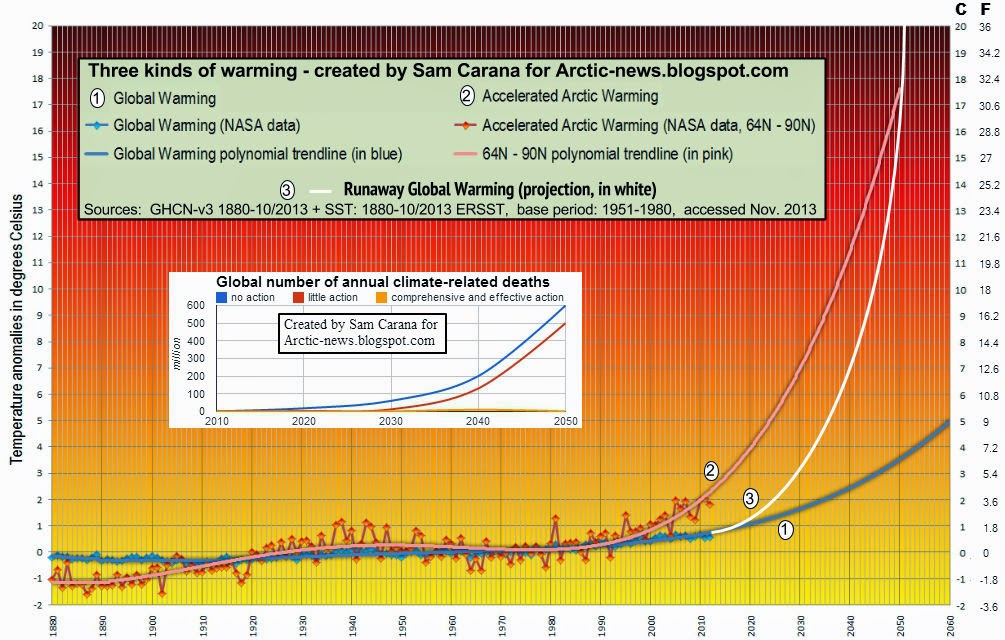
[ click on image to enlarge ]
For further details on a comprehensive and effective climate plan, see the ClimatePlan blog.


Senin, 31 Desember 2012

How to avoid mass-scale death, destruction and extinction


The FAO Food Price Index shows that high food prices have been around for the past few years. The FAO, in its recent Cereal Supply and Demand Brief, explains that we can expect prices to rise, as illustrated below.


The Economic Research Service of the U.S. Department of Agriculture mentions, in its Food Price Outlook, 2012-2013, that the "drought has affected prices for corn and soybeans as well as other field crops which should, in turn, drive up retail food prices".

Global food supply is under stress as extreme weather becomes the new norm. Farmers may be inclined to respond to drought by overusing ground water, or by slashing and burning forest, in efforts to create more farmland. Such practices do not resolve the problems; instead, they tend to exacerbate the problems over time, making things progressively worse.

The diagram below shows that there are many climatological feedbacks (ten of which are pictured) that make climate change worse. At the top, the diagram pictures vicious cycles that are responses by farmers that can add to make the situation even worse. Without effective action, the prospect is that climate change and crop failure combine to cause mass death and destruction, with extinction becoming the fourth development of global warming.

How can we avoid that such a scenario will eventuate? Obviously, once we are in the fourth development, i.e. mass-scale famine and extintion, it will be too late for action. Similarly, if the world moves into the third development, i.e. runaway global warming, it will be hard, if not impossible to reverse such a development. Even if we act now, it will be hard to reverse the second development, i.e. accelerated warming in the Arctic.

The most effective action will target causes rather than symptoms of these developments.

Part 1. Since emissions are the cause of global warming, dramatic cuts in emissions should be included in the first part of the responses. In addition, action is needed to remove excess carbon dioxide from the atmosphere and oceans. Storing the carbon in the soil will also improve soil quality, as indicated by the long green arrow on the left.

Part 2. Solar radiation management is needed to cool the Arctic.

Part 3. Methane management and further action is needed, e.g. to avoid that methane levels will rise further in the Arctic, which threatens to trigger further releases and escalate into runaway global warming. Measures to reduce methane can also benefit soil quality worldwide, as indicated by the long green arrow on the right.

Thus, the proposed action tackles the prospect of mass death and extinction by increasing soil fertility, as illustrated by the image below.


As indicated at the bottom of the image, the most effective policies to accomplish the goals set out in both part 1. and part 3. are feebates, preferably implemented locally.

Kamis, 18 Oktober 2012

Is death by lead worse than death by climate? No.

Paul Beckwith,
B.Eng, M.Sc. (Physics),
Ph.D. student (Climatology)
and Part-time Professor,
University of Ottawa
 
by Paul Beckwith

Is death by lead worse than death by climate? That depends on your perspective. If you are the person dying then death by climate most likely means death by starvation. Or by dehydration. Or by painful vomiting and diarrhea from drinking contaminated water. It seems to me that this slow, painful death by climate would be much worse than catching a lead projectile from afar most likely with little or no warning.

If you are a journalist then penning death by lead stories allows you to write things that appeal to the visceral; namely to write about human conflict between “good” and “evil” and showing vivid images. People seem to innately enjoy reading about the competition of war or battle or insurgency and be able to cheer for a victor. To arms suppliers, it allows them to increase their profit margins. In addition, it allows politicians to have a rallying patriotic cry about the responsibility of their respective country to exercise some muscle with the pretense that they actually care about the well-being people being killed in another far off country. Or say that it is necessary to restore or create some democracy in such a country while ignoring the loss of democracy in their own country. Clearly hypocrisy. Almost inevitably armed intervention leads to a magnification of death and destruction.

How can western politicians, backed by an incredibly supportive and unquestioning main stream media and catering to the interests of large corporations make so much rah-rah about 20,000 people that have experienced death by lead in an internal conflict in one specific year in some other country while completely ignoring the deaths, every single year of 400,000 people?

That is the number of people, mostly children that are dying each year from climate change and carbon economies according to the DARA study that was released September 27th. Somehow this has been ignored up to now. However what politicians cannot ignore so easily is the claim in the same report that the global economy is losing 1.6% of GDP every year due to climate change. Today. Not in a decade or a century but today. This cannot be ignored so easily. In fact the Saturday Globe and Mail discussed the vanishing Arctic sea ice causing global extreme weather events causing global food supply disruption in a lengthy article on the front page of the Sept. 27th Business section. An image of the sea ice minimum of September 16th was even on the next page. Never before in the history of the Globe have I seen such a thing! Why was the article there? Not because of concern for sea ice or worry of extreme weather but because of the 1.6% GDP loss occurring today. Expected to rise to 3.5% of GDP loss 2030. Things are different now. Our world is changing rapidly, in real-time, before our very eyes. Just watch a video of the ice this summer. We have never experienced abrupt climate change before.

For decades, many climatologists have been warning that the energy balance of the earth is out of wack. Now, to the tune of the equivalent of 0.6 Watts per square meter over the entire surface of the planet. Isn’t this small, a Christmas tree bulb is a Watt or two? No. James Hansen calculated that this imbalance is equivalent to the energy of 300,000 Hiroshima sized bombs popping off every single second on every day of the year, year in and year out. Half of this energy is warming the atmosphere and half is warming the ocean. It is not small at all. Sounds like insanity to me. But I am biased. I live and breathe climatology and meteorology. Thus I know the dangers that climate change can bring much more deeply than others and I want to bring others up to speed. Quickly.